
Tipu Sultan: The Tiger of Mysore, A Courageous Ruler and Military Innovator
Remembering the life of Sultan Fateh Ali Sahab Tipu, popularly known as Sher-e-Mysore, who challenged British expansion, strengthened the Kingdom of Mysore and introduced remarkable military and administrative innovations.
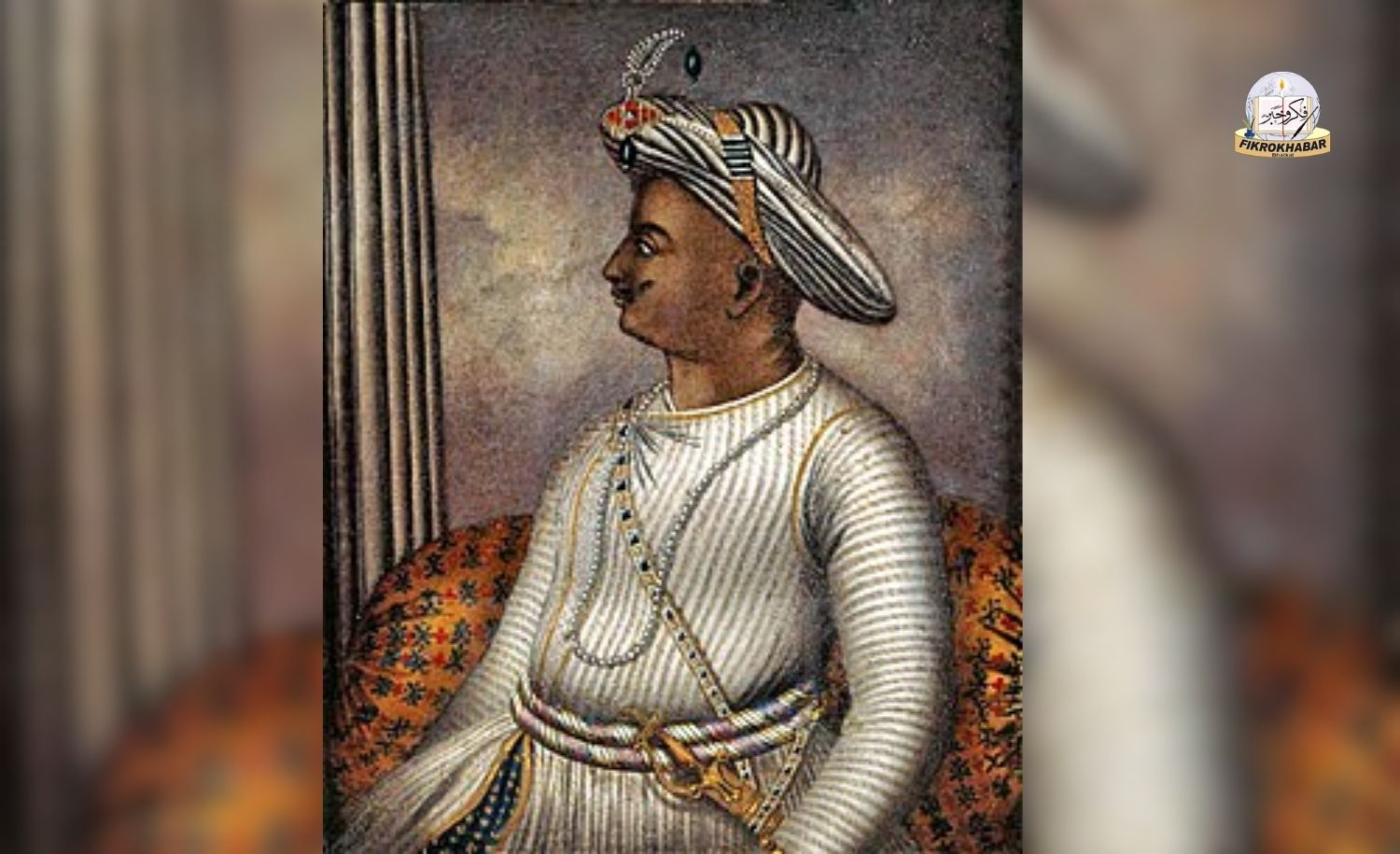

Tipu Sultan, popularly known as Sher-e-Mysore (Tiger of Mysore), was born on 1 December 1751 in Devanahalli, in present-day Bengaluru Rural district of Karnataka.
His full name was Sultan Fateh Ali Sahab Tipu. He was named after Tipu Mastan Aulia, a respected saint of Arcot.
His father, Hyder Ali, was a military officer who gradually rose to become the de facto ruler of the Kingdom of Mysore in 1761. His mother, Fatima Fakhr-un-Nisa, was the daughter of Mir Muin-ud-Din, the governor of the Kadapa fort.
Although Hyder Ali himself had limited formal education, he was determined to provide his son with a strong educational and military foundation. Tipu received instruction in Urdu, Persian, Arabic, Kannada and Beary, along with Quranic studies and Islamic jurisprudence. He was also trained in horse riding, shooting, fencing and military tactics.
From an early age, Tipu was exposed to political affairs and military campaigns. By the age of 17, he was already entrusted with diplomatic and military responsibilities.
Early Military Experience
Tipu Sultan received military training from French officers serving in his father’s army. At just 15 years of age, he accompanied Hyder Ali during the First Anglo-Mysore War in 1766.
He later commanded cavalry forces during the invasion of Carnatic in 1767 and participated in the First Anglo-Maratha War between 1775 and 1779.
These early experiences helped him develop the military knowledge and leadership skills that would later define his rule.
The Second Anglo-Mysore War
Tipu Sultan played a major role in the Second Anglo-Mysore War, particularly during the military campaigns against the British East India Company.
One of his most notable victories came at the Battle of Pollilur in September 1780. Leading approximately 10,000 soldiers and 18 guns, he intercepted the British force commanded by Colonel William Baillie.
Tipu’s forces inflicted a major defeat on the British. Around 200 European soldiers were captured, while the British and their Indian sepoy forces suffered heavy casualties.
He also defeated Colonel Braithwaite’s forces near Annagudi in February 1782, capturing their guns and taking the troops prisoner.
During this period, Tipu also captured important British positions, including Chittur.
In December 1782, his father Hyder Ali passed away while the war was still underway. Tipu subsequently assumed the leadership of Mysore and continued the struggle against the British.
The Second Anglo-Mysore War eventually ended with the Treaty of Mangalore in 1784. The agreement restored the territories held by both sides before the conflict and was considered an important diplomatic achievement for Mysore.
Sultan of Mysore
Following his father’s death, Tipu Sultan consolidated his position as ruler of Mysore. On 29 December 1782, he assumed the title of Badshah, becoming Nawab Tipu Sultan Bahadur.
He was determined to strengthen Mysore’s political independence, military capabilities and economic position.
His reign was marked by continuous efforts to protect the kingdom from British expansion and maintain its influence among the neighbouring powers.
Conflicts with the Maratha Empire
Tipu Sultan also faced political and military challenges from the Maratha Empire.
Disagreements over territorial control, tribute payments and forts previously captured by Hyder Ali led to the Maratha-Mysore War.
The conflict included several military engagements, including the sieges of Nargund, Badami, Adoni and Bahadur Benda, as well as the Battle of Gajendragad.
The war concluded with the Treaty of Gajendragad in March 1787. Under the agreement, Tipu returned several territories and agreed to pay an annual tribute for an agreed period. In return, the Marathas recognised his authority over territories acquired during the conflict.
Despite the agreement, relations between the two powers remained complicated. During the Fourth Anglo-Mysore War, the Marathas eventually supported the British East India Company against Tipu.
Conflicts in Malabar and Travancore
Tipu Sultan was also involved in military campaigns in Malabar and the surrounding regions.
His father, Hyder Ali, had earlier launched campaigns to extend Mysore’s authority over Malabar. Tipu accompanied him during the invasion of 1766, when he was only 15 years old.
Later, Tipu attempted to strengthen Mysore’s control over the region.
In 1789, tensions escalated after the ruler of Travancore acquired two Dutch-held fortresses in Cochin. Tipu considered the acquisition a challenge to Mysore’s interests and launched an attack on the Travancore Lines in December 1789.
The Travancore forces offered strong resistance, and Tipu was unable to break through their defensive positions. Travancore subsequently sought military assistance from the British East India Company.
This confrontation became the immediate trigger for the Third Anglo-Mysore War.
The Third Anglo-Mysore War
The British East India Company formed an alliance with the Marathas and the Nizam of Hyderabad against Tipu Sultan.
In 1790, British forces advanced into Mysore territories, capturing important positions in the Coimbatore region. Tipu launched counterattacks and managed to recover much of the territory, although the British retained control of Coimbatore.
In 1791, the British army under Lord Cornwallis advanced towards Bangalore and threatened Srirangapatna, the capital of Mysore.
Tipu attempted to disrupt British supply routes and prevent the advancing forces from accessing local resources. However, the combined strength of the allied armies eventually placed Mysore under severe pressure.
In 1792, the allied forces reached Srirangapatna and laid siege to the capital.
Tipu was forced to negotiate peace through the Treaty of Seringapatam. Under its terms, he surrendered approximately half of his territories to the allied powers and agreed to pay a substantial war indemnity.
As security for the payment, two of his young sons were handed over to the British as hostages. They were later released after the indemnity was paid.
The treaty was a major setback for Mysore and significantly reduced the kingdom’s territory and resources.
Relations with France and Napoleon Bonaparte
Tipu Sultan recognised the importance of international alliances in resisting British expansion.
He maintained diplomatic relations with France, which was also engaged in a struggle against British influence.
During the late eighteenth century, Napoleon Bonaparte considered establishing a French presence in Egypt and extending French influence towards India. One of his strategic objectives was to establish contact with Indian rulers, including Tipu Sultan, to challenge British power.
However, Napoleon’s military campaigns in the Middle East did not succeed in establishing the proposed connection with Mysore.
Tipu’s efforts to secure foreign support reflected his determination to resist the growing influence of the British East India Company.
Tipu Sultan’s Special Connection with Bhatkal
Bhatkal, a historic coastal town in Karnataka, holds a special place in the story of Tipu Sultan. Local historical accounts and community records associate his family with the Nawayath community of Bhatkal. According to accounts shared during Tipu Jayanti programmes in the town, his grandmother belonged to the Bhatkal Nawayath community. Local reports have also mentioned family connections through his marriage.
One of the most significant reminders of this historical connection is Sultani Masjid, also known as Sultan Masjid, located on Sultan Street in Bhatkal. The mosque is traditionally associated with Tipu Sultan and is remembered by local residents as a symbol of his connection with the town.
Historical accounts of Bhatkal attribute the construction of the mosque to Tipu Sultan around 1793. The mosque is regarded as an important part of the town’s heritage and reflects the historical relationship between the Kingdom of Mysore and the Canara coast.
Bhatkal also had strategic importance during the Mysore period. Hyder Ali and Tipu Sultan used the coastal region as an important base for their naval activities.
For the people of Bhatkal, this connection gives Tipu Sultan’s history a local significance beyond his military campaigns and political achievements. Sultani Masjid remains a visible reminder of the historical links between the Tiger of Mysore and the Nawayath town of Bhatkal.
Administrative and Economic Reforms
Apart from his military activities, Tipu Sultan introduced several administrative innovations during his reign.
He established new government departments, introduced a revised calendar and developed a new coinage system.
He also implemented changes to the land revenue administration and encouraged commercial and industrial development.
The Mysore economy experienced significant growth during his reign, with particular attention given to agriculture, trade and manufacturing.
Tipu supported the development of the Mysore silk industry, which later became an important part of the region’s economic identity.
He is also associated with the patronage of Channapatna toys, a traditional craft that continues to be recognised as one of Karnataka’s distinctive handicraft traditions.
Pioneer of Military Rocket Technology
One of Tipu Sultan’s most remarkable contributions was the development and extensive military use of iron-cased rockets.
His father, Hyder Ali, had already introduced improvements in the use of rockets in the Mysore army. Tipu expanded the technology and organised specialised rocket artillery units known as Cushoons.
Unlike earlier rockets that generally used weaker construction materials, Mysorean rockets employed iron tubes to contain the propellant. This allowed them to generate greater thrust and travel longer distances.
Tipu’s army developed organised rocket-launching units, with thousands of trained personnel assigned to operate these weapons.
The rockets were deployed against British forces during the Anglo-Mysore Wars, particularly at the Battle of Pollilur and the defence of Srirangapatna.
Their ability to cause confusion and damage among advancing troops made them an important part of Mysore’s military strategy.
After the fall of Srirangapatna in 1799, the British captured several Mysorean rockets. These weapons were subsequently studied and influenced the development of the Congreve rockets in Britain, which were later used during the Napoleonic Wars.
Tipu Sultan also commissioned the military manual Fathul Mujahidin, which documented aspects of military organisation and warfare.
His work in expanding rocket artillery remains an important chapter in the history of military technology.
Naval and Military Development
Tipu Sultan also recognised the importance of developing a strong navy.
In 1786, he initiated plans to establish a naval force consisting of battleships and frigates. He appointed naval officers and established dockyards at Jamalabad and Majidabad.
His naval administration was intended to strengthen Mysore’s maritime capabilities and protect its coastal interests.
On land, he continued developing a disciplined standing army with specialised military units and trained personnel.
The use of European military techniques, particularly those learned through French officers, helped modernise Mysore’s armed forces.
The Fourth Anglo-Mysore War
Despite his military setbacks, Tipu Sultan continued to resist British expansion.
The British East India Company remained determined to eliminate Mysore’s independent military power. In 1799, British forces, supported by the Marathas and the Nizam of Hyderabad, launched a major campaign against Tipu.
Three allied forces advanced towards Mysore, with Srirangapatna becoming their principal target.
The British army, under General George Harris, surrounded the capital. Tipu’s forces faced a considerably larger and better-supported enemy.
After intense fighting, the British breached the fortifications of Srirangapatna on 4 May 1799.
According to historical accounts, Tipu was advised to escape through a secret passage and continue the resistance from another stronghold. However, he refused to abandon his capital.
He continued fighting alongside his soldiers and was killed during the battle near the Hoally Gate of Srirangapatna Fort.
Tipu Sultan’s body was recovered after the fighting and buried near the tomb of his father, Hyder Ali, at the Gumbaz in Srirangapatna.
“Better to Live One Day as a Tiger”
Tipu Sultan is widely associated with the famous saying:
“Better to live one day as a tiger than a thousand years as a sheep.”
The statement has become closely connected with his image as a ruler who preferred resistance over submission.
His determination to defend Mysore until his final moments contributed to his enduring reputation as the Tiger of Mysore.
Death and Legacy
Tipu Sultan died on 4 May 1799 while defending Srirangapatna against the combined forces of the British East India Company and its allies. He was 47 years old.
His death marked the end of an important chapter in the history of the Kingdom of Mysore and strengthened British control over southern India.
Today, Tipu Sultan is remembered for his resistance against British colonial expansion, his military leadership, his administrative reforms and his contribution to rocket technology.
His summer palace at Srirangapatna, the Gumbaz where he is buried and other historical monuments associated with his reign continue to attract visitors and historians.
His life remains a significant subject of historical discussion, particularly regarding the political and military struggles of eighteenth-century India.
Tipu Sultan: One of India’s Earliest Major Resisters of British Rule
Tipu Sultan is widely remembered as one of the earliest and most prominent Indian rulers to wage a determined military struggle against the expansion of British colonial power.
He fought four Anglo-Mysore Wars alongside his father and later as the ruler of Mysore. Even after suffering territorial losses and facing powerful alliances, he refused to accept British supremacy.
For this reason, he is often honoured by admirers as one of India’s earliest freedom fighters. Although the title of the “first Indian freedom fighter” is historically debated, his resistance against the East India Company remains a significant chapter in India’s struggle against colonial expansion.
His courage, military innovations and determination to defend his kingdom until his final moments have secured his place in history.
For Bhatkal, his legacy carries an additional meaning through the reported Nawayath family connection and the historic Sultani Masjid on Sultan Street.
More than two centuries after his death, Tipu Sultan continues to be remembered as the Tiger of Mysore, a ruler whose life and resistance remain part of India’s historical heritage.