
Allama Muhammad Iqbal: The Poet of the East, Philosopher and Visionary of the Muslim World
Remembering the life and legacy of Sir Muhammad Iqbal, whose poetry, philosophy and vision inspired generations and left a lasting mark on Islamic thought and Urdu and Persian literature.
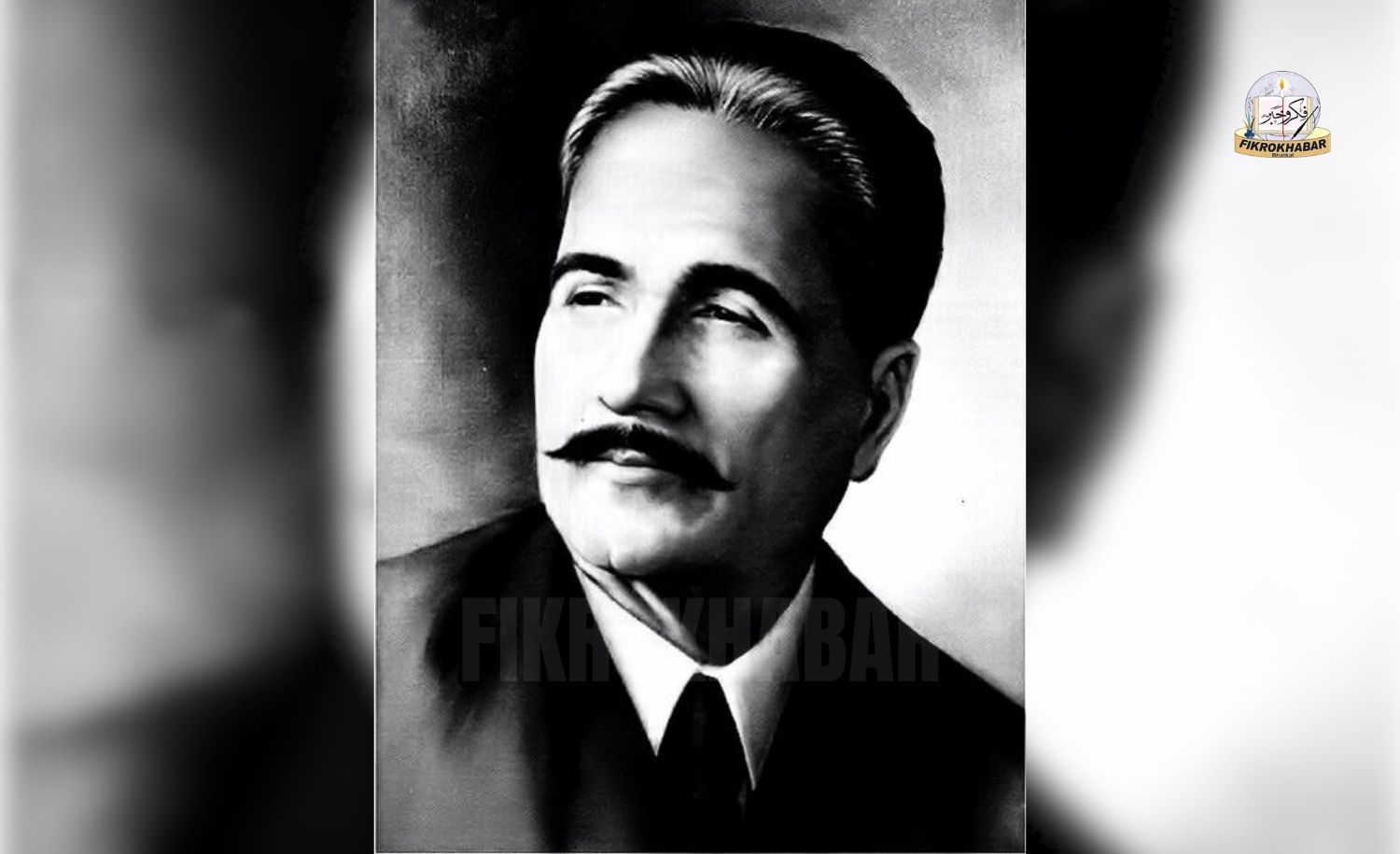

Allama Sir Muhammad Iqbal was born on 9 November 1877 in Sialkot, Punjab, British India (now in Pakistan). He belonged to a family of Kashmiri ancestry whose forefathers had embraced Islam several generations earlier.
His father, Sheikh Noor Muhammad, was a tailor by profession and a deeply religious man, while his mother, Imam Bibi, was known for her humility, kindness and concern for the poor and needy. Iqbal shared a close bond with his mother, and her death on 9 November 1914 deeply affected him. He expressed his grief through a moving elegy in her memory.
From an early age, Iqbal showed an exceptional interest in education, literature and poetry. His intellectual development was shaped by his family environment and the guidance of his teachers, particularly his early Arabic and Persian teacher, Syed Mir Hassan.
Education and Academic Journey
Iqbal began learning the Quran at the age of four at a local mosque. He subsequently studied Arabic and Persian under Syed Mir Hassan, a distinguished scholar and professor of Arabic at Scotch Mission College in Sialkot.
He matriculated in 1893 and completed his intermediate education in 1895. He then joined Government College, Lahore, where he studied philosophy, English literature and Arabic. In 1897, he obtained his Bachelor of Arts degree and was awarded a medal for his outstanding performance in Arabic.
In 1899, he completed his Master’s degree in Philosophy from the same institution, securing first position at the University of the Punjab.
His academic achievements and intellectual abilities soon established him as a promising scholar and poet.
Higher Studies in Europe
In 1905, encouraged by his philosophy teacher Sir Thomas Arnold, Iqbal travelled to England to pursue higher education.
He enrolled at Trinity College, Cambridge, where he studied philosophy and graduated with a second Bachelor’s degree in 1906. During the same year, he qualified as a barrister at Lincoln’s Inn.
He subsequently moved to Germany to pursue doctoral studies. On 4 November 1907, he was awarded a Doctor of Philosophy degree by Ludwig Maximilian University of Munich for his thesis titled The Development of Metaphysics in Persia. The thesis was later published in London in 1908.
During his stay in Europe, Iqbal also developed an understanding of Western philosophy and literature. He studied the works and ideas of prominent European thinkers, including Friedrich Nietzsche, Henri Bergson and Johann Wolfgang von Goethe.
His exposure to different intellectual traditions broadened his philosophical outlook. At the same time, he remained deeply connected to Islamic thought and the spiritual heritage of the Muslim world.
His European education played an important role in shaping his later writings, in which he frequently examined the relationship between Eastern spirituality and Western intellectual and material progress.
Academic and Professional Career
After returning to India in 1908, Iqbal resumed his academic career in Lahore. He worked as a professor of philosophy and English literature at Government College and had earlier served as a teacher of Arabic at Oriental College.
Although he briefly practised law at the Lahore High Court, his primary interests increasingly turned towards philosophy, literature, religion and public affairs.
He became actively associated with Anjuman-e-Himayat-e-Islam, an organisation working for the educational and social advancement of Muslims. In 1919, he became its General Secretary.
His academic and literary activities gradually brought him recognition as one of the most influential Muslim intellectuals of his time.
Philosophical Thought and the Concept of Khudi
One of the most significant contributions of Allama Iqbal was his philosophy of Khudi, or selfhood.
Through his poetry and philosophical writings, he encouraged individuals to recognise their inner potential, develop strong character, cultivate self-respect and work towards a meaningful purpose in life.
For Iqbal, Khudi was not an expression of arrogance or selfishness. Rather, it represented the development of the human personality through faith, love, determination, knowledge and action.
He believed that individuals should not surrender to circumstances or accept weakness and passivity as their destiny. Instead, they should develop their abilities and contribute positively to society.
His philosophical vision was deeply influenced by the teachings of the renowned Persian Sufi poet and scholar Jalaluddin Rumi, whom he regarded as his spiritual guide.
Iqbal also emphasised the importance of the Muslim Ummah, urging Muslims to overcome internal divisions, rediscover their intellectual heritage and regain their spiritual and moral strength.
His thoughts sought to connect Islamic principles with the challenges of the modern world.
Contributions to Urdu and Persian Literature
Allama Iqbal is widely regarded as one of the greatest poets of the twentieth century. His literary contributions in Urdu and Persian brought a new dimension to poetry, combining philosophical depth, spiritual reflection and a powerful message of self-realisation.
Although he wrote in several languages, a significant portion of his poetry was composed in Persian. He believed that Persian provided him with a wider scope to express his philosophical ideas.
His Persian works received considerable appreciation in Iran and other parts of the Persian-speaking world.
Some of his notable Persian works include:
- Asrar-e-Khudi (The Secrets of the Self), published in 1915, which presents his philosophy of selfhood and personal development.
- Rumuz-e-Bekhudi (The Secrets of Selflessness), published in 1917, which explores the relationship between the individual and society and the importance of collective responsibility.
- Payam-e-Mashriq (The Message of the East), published in 1924, which presents a philosophical response to Western intellectual traditions and highlights the importance of spirituality and moral values.
- Zabur-e-Ajam (Persian Psalms), published in 1927, containing philosophical and spiritual poetry.
- Javid Nama (The Book of Javid), published in 1932, a philosophical and mystical poetic work named after his son Javid.
- Pas Cheh Bayad Kard Ai Aqwam-e-Sharq (What Should We Do, O Nations of the East?), which addresses the intellectual and spiritual condition of Eastern societies.
His major Urdu works include:
- Bang-e-Dara (The Call of the Marching Bell), published in 1924, his first major collection of Urdu poetry. It includes patriotic, historical, philosophical and religious poems.
- Bal-e-Jibril (Wings of Gabriel), published in 1935, widely regarded as one of his finest collections of Urdu poetry.
- Zarb-e-Kalim (The Rod of Moses), published in 1936, a collection of philosophical poetry addressing the social, political and moral challenges of the modern age.
- Armughan-e-Hijaz (The Gift of Hijaz), published posthumously in 1938, containing poetry in both Persian and Urdu.
Among his most widely recognised poems is Tarana-e-Hindi (Anthem of the Indians), popularly known for its opening line, “Saare Jahan Se Achha Hindustan Hamara”. The poem became an enduring expression of patriotism and continues to be remembered in India.
His poem Tarana-e-Milli and other compositions also reflect his concern for the spiritual and collective identity of the Muslim Ummah.
The Reconstruction of Religious Thought in Islam
Apart from poetry, Iqbal made important contributions to Islamic philosophy through his English-language lectures.
His lectures on Islamic religious thought, delivered at different educational centres including Madras, Hyderabad and Aligarh, were later compiled into the influential book The Reconstruction of Religious Thought in Islam.
Published in book form in 1934, the work examined Islamic philosophy, religious experience, human consciousness, prayer, spirituality and the relationship between religion and modern civilisation.
Through these lectures, Iqbal sought to encourage a renewed understanding of Islamic thought in the light of contemporary intellectual developments.
He believed that Muslims needed to engage with modern knowledge while remaining firmly rooted in the fundamental teachings and spiritual principles of Islam.
The book remains one of his most important contributions to modern Islamic philosophical discourse.
Political Thought and the Allahabad Address
Allama Iqbal was not only a poet and philosopher but also an active participant in the political developments of his time.
He became associated with the All-India Muslim League and was elected to the Punjab Legislative Council in 1927.
In December 1930, he presided over the annual session of the All-India Muslim League at Allahabad. His presidential address, commonly known as the Allahabad Address, outlined his vision of bringing the Muslim-majority provinces of north-western India, including Punjab, the North-West Frontier Province, Sindh and Balochistan, together into a consolidated political unit.
His address became an important landmark in the political history of the Indian subcontinent and contributed to the development of the political vision that later became associated with the Pakistan Movement.
Iqbal also maintained a close intellectual and political correspondence with Muhammad Ali Jinnah. Through his letters, he encouraged Jinnah to provide leadership to Indian Muslims and work towards safeguarding their political and social interests.
Although Iqbal passed away before the establishment of Pakistan in 1947, his political ideas and the Allahabad Address continued to influence subsequent political developments.
Travels and Intellectual Engagement
Iqbal travelled extensively during his lifetime, including visits to England, Germany, Spain, Egypt, Afghanistan, Iran and Turkey.
His travels exposed him to different cultures, intellectual traditions and political circumstances. He frequently reflected on the condition of Muslim societies and the challenges facing the Islamic world.
His visit to Spain in 1933 was particularly significant. He visited the historic Mosque of Cordoba, and the experience inspired some of his memorable poetic compositions.
He also travelled to Afghanistan, where he participated in discussions concerning educational and intellectual development, including the establishment of Kabul University.
Through his writings and public engagements, he consistently advocated spiritual revival, intellectual independence and greater cooperation among Muslim nations.
Final Years and Demise
During the final years of his life, Iqbal suffered from a prolonged throat illness that gradually affected his health.
Despite his deteriorating condition, he remained engaged in intellectual and public activities. He continued to write, offer guidance and express his views on the religious, social and political challenges facing Muslims.
He passed away on 21 April 1938 in Lahore at the age of 60.
His death was a great loss to the literary, intellectual and Muslim communities of the subcontinent.
He was laid to rest in Hazuri Bagh, near the entrance of the historic Badshahi Mosque and Lahore Fort. His tomb, known as Mazar-e-Iqbal, remains an important historical and cultural landmark.
Recognition and Lasting Legacy
Allama Muhammad Iqbal is remembered as the Poet of the East, Hakeem-ul-Ummah and Mufakkir-e-Pakistan. His intellectual and literary contributions earned him recognition across the Muslim world and beyond.
His poetry has been translated into numerous languages, including English and several European and Asian languages. His Persian works received particular appreciation in Iran, where he is commonly known as Iqbal-e-Lahori.
His ideas also influenced prominent intellectuals and political figures in different countries. His message of self-realisation, spiritual awakening, dignity and intellectual independence continues to attract readers across generations.
In Pakistan, he is officially recognised as the national poet, and his birthday, 9 November, is observed as Iqbal Day.
In India, his patriotic composition Tarana-e-Hindi continues to hold a special place in the country’s literary and cultural heritage. Several educational and cultural institutions have also been named after him.
His writings remain widely studied by students, researchers, philosophers and lovers of Urdu and Persian literature.
A Vision That Continues to Inspire
Allama Muhammad Iqbal’s life was a remarkable combination of scholarship, poetry, philosophy and public service. He used the power of his pen to awaken minds, challenge intellectual stagnation and encourage individuals and communities to rediscover their strength and purpose.
His message went beyond literary expression. He sought to inspire a generation that valued knowledge, faith, self-respect, hard work and spiritual development.
Through his poetry and philosophical writings, Iqbal left behind a legacy that continues to influence intellectual discussions and inspire generations across the world.
His life remains a reminder of the transformative power of knowledge, the importance of intellectual independence and the enduring role of literature in shaping societies.