
The Importance and Relevance of Muslim Personal Law and Our Responsibilities in the Present Circumstances
All India Muslim Personal Law Board: A Glorious Struggle of More Than Half a Century for the Protection of Shariah
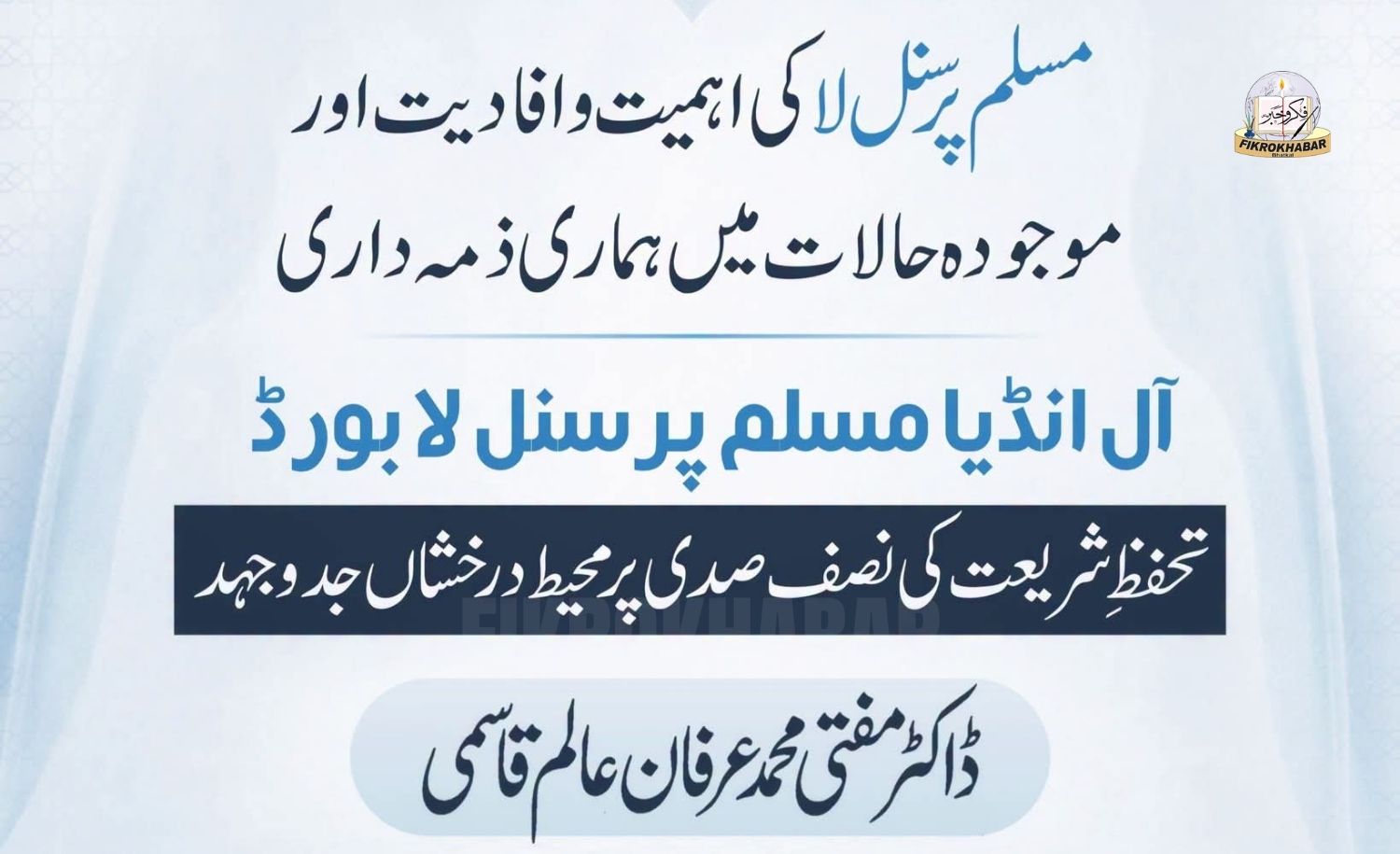

By: Dr. Mufti Muhammad Irfan Alam Qasmi
Islam is not merely a collection of rituals or religious ceremonies; rather, it is a complete, comprehensive, and eternal way of life that provides divine guidance for every aspect of human existence individual, social, economic, familial, judicial, and moral. The laws relating to marriage, divorce, inheritance, wills, family affairs, and social dealings, derived from the Qur’an and Sunnah, are collectively known as Muslim Personal Law or Islamic Family Law. These laws safeguard the religious identity, family stability, cultural uniqueness, and religious freedom of Muslims.
In a diverse and pluralistic country like India, the significance of Muslim Personal Law becomes even greater because the Constitution of India guarantees every religious community the fundamental right to live according to its faith and personal laws. Therefore, the protection of Muslim Personal Law is not merely a legal issue; it is also a matter of preserving religious freedom, constitutional rights, cultural identity, and democratic values.
At a time when issues such as Muslim Personal Law, Waqf properties, religious freedom, and the Uniform Civil Code are being widely debated at the national level, the responsibility of the Muslim community increases manifold. It is essential that the community works with wisdom, unity, constitutional awareness, and foresight to protect its religious and constitutional rights. In such circumstances, the need for a united and representative platform that can effectively voice the concerns of the community is greater than ever.
All India Muslim Personal Law Board: A Symbol of Unity
It was with this sense of responsibility that the All India Muslim Personal Law Board (AIMPLB) was established in 1973. Today, it stands as the largest, most respected, and representative collective platform of Indian Muslims. For more than five decades, it has played a vital role in providing religious, legal, and constitutional guidance to the Muslim community.
The establishment of this institution demonstrates that Indian Muslims can rise above sectarian and organizational differences and unite for the protection of Islamic law, religious freedom, and collective community interests. This unity remains the Board’s greatest strength and historical achievement.
A Legacy of Wisdom, Determination, and Perseverance
The late Islamic thinker Maulana Muhammad Wali Rahmani described the history of the Muslim Personal Law Board as:
“The history of the Muslim Personal Law Board is the history of people filled with faith and conviction; a history of insight, courage, determination, patience, wisdom, and action. Caution that leads to cowardice, patience that becomes indifference to injustice, or tolerance that results in inaction can never be accepted by living individuals and dynamic institutions.”
These words aptly summarize the Board’s long struggle. The institution has always preferred wisdom over provocation, constitutional methods over confrontation, and unity over division. This approach is the secret behind its credibility and enduring influence.
Objectives and Distinctive Features
The purpose of the Board extends beyond the protection of Muslim family laws. It also seeks to promote goodwill, cooperation, and mutual trust among different Islamic schools of thought and religious organizations, thereby presenting a united voice on matters affecting the Muslim community.
The Board firmly believes that unity does not require the elimination of doctrinal or jurisprudential differences. Rather, Muslims can remain committed to their respective schools of thought while uniting on issues of common concern.
As a result, scholars and leaders belonging to Deobandi, Barelvi, Ahl-e-Hadith, Shia, Hanafi, Shafi’i, Bohra, and other traditions have worked together under this platform for the protection of shared religious and community interests.
Muslim Personal Law: Foundation of Religious Freedom and Cultural Identity
Muslim Personal Law is not a special privilege or temporary legal concession. It is a natural and constitutional expression of the right of Muslims to regulate their family affairs including marriage, divorce, inheritance, and wills in accordance with Islamic teachings.
The Constitution of India guarantees religious freedom and cultural diversity. Every community has the right to preserve its traditions and manage its religious affairs according to its beliefs. Therefore, safeguarding Muslim Personal Law is not merely a Muslim issue; it is also connected to the preservation of India’s pluralistic and democratic character.
Our Responsibilities in the Present Situation
Current circumstances require Muslims to rise above emotional reactions and internal divisions and instead adopt wisdom, unity, and constitutional awareness.
Every Muslim should:
- Strengthen personal adherence to Islamic teachings.
- Promote Islamic values within the family.
- Educate younger generations about Islamic identity and culture.
- Participate in lawful and constitutional efforts aimed at protecting religious freedom and community rights.
- Support initiatives that promote national harmony and mutual respect.
Differences of opinion may naturally exist, but on collective issues affecting the community, unity, trust, and cooperation are essential.
The Contemporary Importance of the AIMPLB
In present circumstances, the role of the All India Muslim Personal Law Board has become even more significant. For over fifty years, it has represented Muslim religious and family rights through peaceful and constitutional means.
The Board has consistently emphasized patience, wisdom, moderation, unity, and legal struggle. Such an approach remains the most effective path within a democratic framework.
The community should therefore strengthen this collective platform, support its legitimate constitutional efforts, and set aside differences on matters that concern the future, identity, and religious freedom of Indian Muslims.
Waqf and the Need for Collective Awareness
The institution of Waqf has historically played a vital role in supporting religious, educational, and charitable activities. Mosques, schools, orphanages, hospitals, cemeteries, and numerous welfare institutions have been established and maintained through Waqf resources.
In India as well, Waqf properties represent a valuable religious and social asset belonging to the community as a whole rather than to individuals. Therefore, protecting these properties is not merely a legal obligation but also a religious, moral, and communal responsibility.
Recent legal developments and proposed amendments concerning Waqf have raised concerns among Muslims regarding the autonomy, administration, and protection of Waqf properties. In such matters, emotional responses are not beneficial; rather, informed discussion, constitutional awareness, and lawful engagement remain the appropriate course of action.
Uniform Civil Code and India’s Pluralistic Identity
India’s strength lies in its diversity. The Constitution recognizes and protects the country’s rich religious and cultural pluralism.
In this context, Muslim Personal Law represents not merely a legal framework but also an expression of Muslim religious identity and commitment to Islamic teachings. Matters such as marriage, divorce, inheritance, and family relations are regarded by Muslims as religious obligations derived from the Qur’an and Sunnah.
Therefore, any national discussion concerning personal laws should take into account the concerns, views, and constitutional rights of all communities involved.
The Path Forward: Hope, Wisdom, and Perseverance
The present era demands extraordinary wisdom and seriousness. The protection of Shariah cannot be achieved merely through slogans or resolutions; it requires:
- Strong family values and Islamic education.
- Unity and cooperation among community institutions.
- Constitutional and peaceful engagement.
- Patience, wisdom, and steadfastness.
- Faith in Allah and constructive participation in society.
No matter how challenging the circumstances may be, Muslims should never lose hope. The true means of protecting rights lie in knowledge, character, unity, patience, and trust in Allah.
The message of our times is clear: while preserving religious identity and constitutional rights, Muslims should continue to contribute positively toward peace, justice, mutual respect, and national harmony. This is the path shown by our scholars, the spirit of the Constitution of India, and the hallmark of a responsible and dignified citizen.
This Article is Translated from Urdu to English that has been Published by AIMPLB Official Social Media Platform