
Late Abdul Hameed Damudi- A Philanthropic Soul
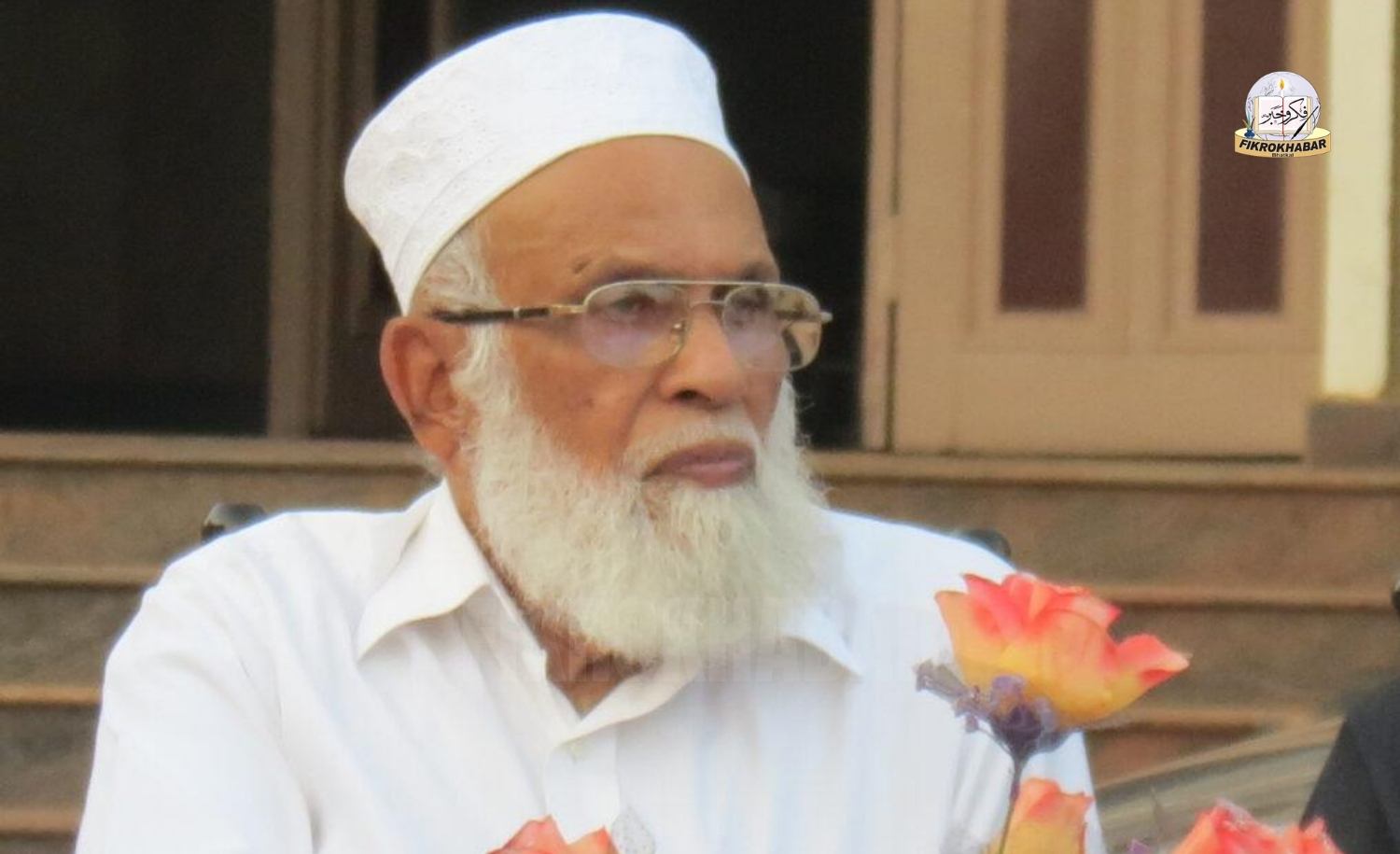

Written by Abdul Mateen Muniri (Bhatkal)
With the passing of Abdul Hameed Damudi on 16 May, a bright chapter in the history of Bhatkal came to an end. He had the distinction of being among the early supporters of establishing a religious educational institution in Bhatkal in 1962. When a delegation consisting of Dr. Ali Malpa and Saada Muhammad Jafri, along with D.A. Muhammad Ismail and others, traveled to Mumbai to consult Bhatkal’s merchants and philanthropists, it was through the encouragement of companions like Abdul Hameed Damudi that a meeting of the Bhatkal Muslim Jamaat Mumbai was convened under the chairmanship of Haji Mohiuddin Muniri.
The proceedings of that historic meeting, recorded in the first report of 1964 of Jamia Islamia Bhatkal, immortalized the names of Abdul Hameed Damudi and the participants. An excerpt reads:
“A consultative meeting was held at the residence of D.A. Abubakar and Ismail on Ibrahim Rahmatullah Road, Mumbai, on the night of 26 March 1962, under the chairmanship of Mohiuddin Muniri. The purpose was to discuss further with the Mumbai community the proposal to establish an Arabic Darul Uloom in Bhatkal. After consultation, the proposed institution was named ‘Jamia Islamia.’
Even more remarkable was the enthusiasm shown by the younger members connected to D.A. Abubakar and D.A. Ismail ,Abdul Hameed Damudi, Ismail Damudi, Muhammad Saeed Mohiuddin Damudi, and Muhammad Saeed Hussain Damudi. Inspired by the discussions on religious education they had been hearing at home, they voluntarily announced a contribution of one thousand rupees from their own pockets, without any request or prompting. Today, these same young men are owners of ‘Abuco Traders.’ We pray for their success in this world and the Hereafter.”
To understand the significance of that contribution, it should be remembered that in 1960, ten grams of gold in India cost around 63 rupees.
Abdul Hameed Damudi was born in 1930 in Khalifa Mohalla, in the very house that once belonged to the great benefactor of the community, Ismail Hassan Siddiq.
At that time, children were usually not admitted to school before the age of six or seven. After receiving elementary education at home, he enrolled in Anjuman Islamia Anglo Urdu High School in Bhatkal, which then stood on the Main Road near the Government Board Primary School.
Among the personalities who deeply influenced his upbringing was Haji Mohiuddin Muniri, who taught him in the third standard. This teacher-student relationship later evolved into close friendship and companionship, extending from Bhatkal to Mumbai. Whenever Muniri Sahib planned a beneficial project for the community, Abdul Hameed Damudi was among the first people he approached for support. His contributions toward the establishment of institutions such as Jamia and Jamiat-us-Salihat were rooted in this companionship.
In his early days in Mumbai, under Muniri Sahib’s guidance, he and a few like-minded friends established a welfare fund for community service, contributing part of their earnings to it. However, due to objections about creating a new fund while the Jamaat already existed, the initiative did not continue for long.
Damudi Sahib had a deep love for reading. Despite his busy commercial life, he remained attached to books and learning. He often said that this passion too was inherited from Mohiuddin Muniri. He recalled that during his childhood, Muniri Sahib once organized a handwriting competition in which students beautifully copied Surah At-Takathur. Abdul Hameed Damudi won first prize and received a book titled Aakhri Paighambar (“The Last Prophet”).
In Mumbai, he also had the privilege of studying for seven years under Maulana Qazi Sharif Mohiuddin Akrami, a renowned scholar and jurist who effectively managed the judicial affairs of Mumbai’s Muslim community.
When Abdul Hameed Damudi was only six years old, his father passed away in 1936 due to cholera. At that time, Bhatkal lacked even basic medical facilities. His grandfather was a large landowner with agricultural estates in places such as Karminjeshwar, but the family still faced difficulties after his father’s death.
His uncle, D.A. Abubakar, along with cousin D.A. Ismail, had established a business in Mumbai in 1932 under the name “D.A. Abubakar & Ismail.” After his father’s passing, D.A. Abubakar became his guardian. In 1942, he moved Abdul Hameed from Bhatkal’s Anjuman School to Mumbai, where he studied at Ahmed Sailor School and later at Ismail Baig Muhammad High School, one of the most prestigious Muslim educational institutions of that era.
The principal, Daud Sahib, was a remarkable educator who had graduated with first-class honors from St. Xavier’s College during British rule. a rare achievement among Muslims at the time. Though he could have pursued great worldly success, he dedicated his life to serving the community through education.
In 1949, Abdul Hameed Damudi passed his SSLC examinations with distinction. Soon after, he joined the family business, D.A. Abubakar & Ismail. At the age of seventeen or eighteen, his uncle arranged his marriage with the daughter of his cousin and business partner D.A. Ismail. Just days after the wedding, he was sent back to Mumbai for work and did not return home for three years.
He worked for fourteen years in D.A. Abubakar & Ismail during its golden era. At the time, many Arab traders from the Gulf visited Mumbai. Through his honesty, hospitality, and service, he built strong relationships with them. Among those who trusted him deeply was the noted Dubai businessman Sheikh Abdullah Al Ghurair, whom he cared for during an illness in Mumbai.
In 1962, Abdul Hameed Damudi and his close associates Ismail Damudi, Muhammad Saeed Mohiuddin Damudi, and Saeed Hussain Damudi, resigned from their jobs and decided to start their own venture. In 1963, they founded “Abuco Traders.” Around the same time, Saeed Hussain Damudi moved to Dubai and established “Al Nuwait Traders” for import-export business, becoming one of the earliest Bhatkalis to settle there. Abdul Hameed Damudi joined him in Dubai in 1966, and together they managed the business for decades.
As more Bhatkalis gathered in Dubai, it was at Abdul Hameed Damudi’s residence that the foundation of the Nawait Muslim Association was laid, which later evolved into the Bhatkal Muslim Jamaat Dubai.
Throughout his life in Dubai, scholars, community leaders, and representatives of religious institutions visiting from India considered meeting him essential. He welcomed people from all schools of thought with warmth and respect.
During the last thirty years of his life, he developed a particularly strong attachment to Nadwatul Ulama. Great scholars like Maulana Syed Abul Hasan Ali Nadwi held him in affection and remembered him in their prayers.
Together with Haji Mohiuddin Muniri, he remained associated from the very beginning with Jamia Islamia Bhatkal and Jamiat-us-Salihat, supporting them financially, morally, and intellectually. He also supported many educational and religious institutions, including Anjuman Hami-e-Muslimeen and Madrasah Taleem-ul-Quran in Tengingundi.
Abdul Hameed Damudi lived a long and blessed life, nearly completing a full century according to the Hijri calendar. His life was admirable in every respect filled with generosity, service, humility, and devotion to education and religion.
May Allah elevate his ranks and grant him eternal peace. Ameen.
This article is translated into English.