
Karnataka Muslim bodies accuse Congress govt of “soft Hindutva”, question “unfulfilled promises”
Muslim groups in Karnataka questioned the Congress government over reservation, hijab, Waqf issues and political representation during a convention held in Bengaluru.
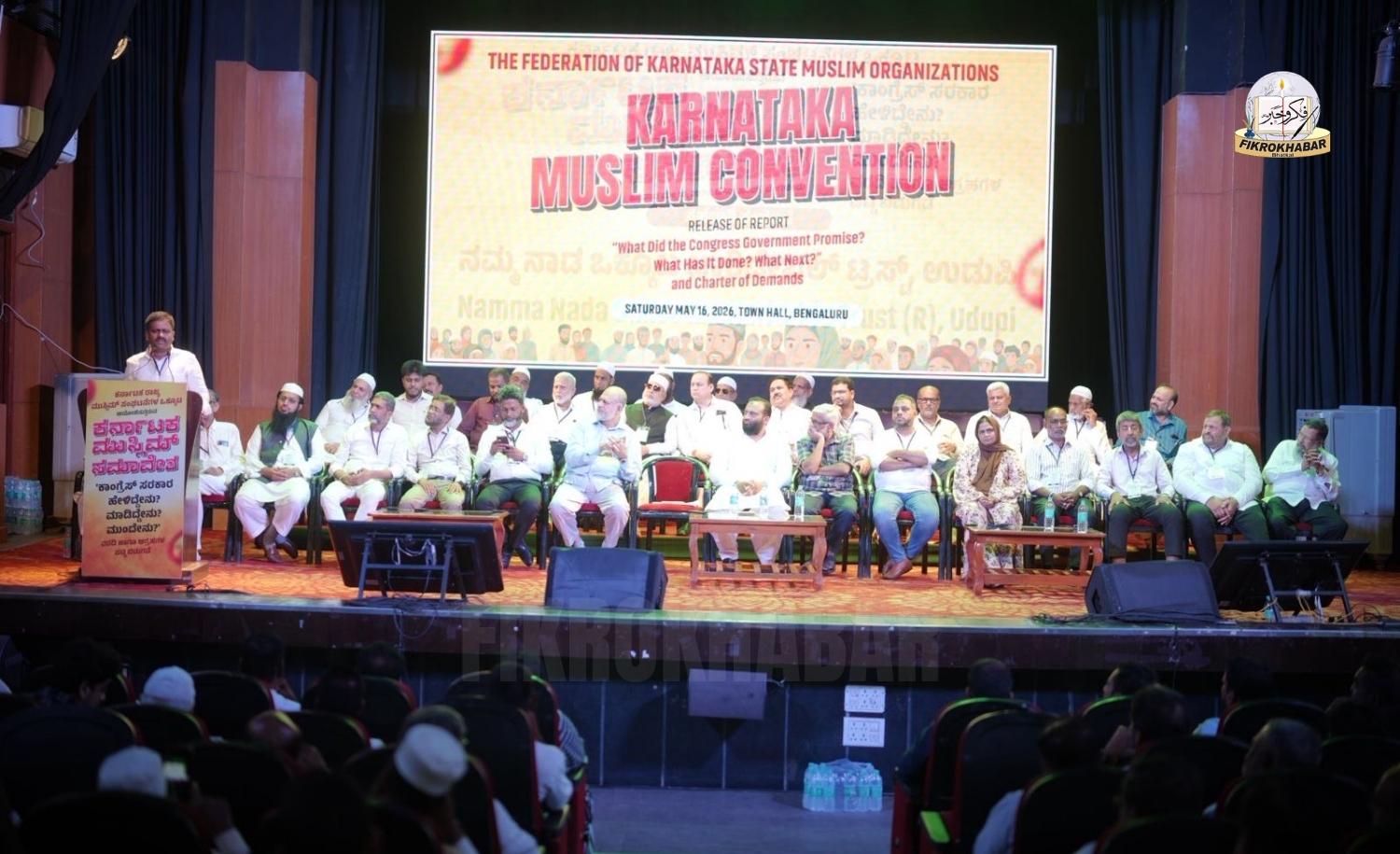

The Karnataka Federation of Muslim Organisations on Saturday sharply questioned the Congress government over what it described as “unfulfilled promises” to the Muslim community despite being in power for three years in Karnataka, while releasing a report addressing issues including reservation, political representation and the upcoming Special Intensive Revision (SIR) of electoral rolls.
The Karnataka Muslim Convention was held at Town Hall in Bengaluru under the slogan, “What did the Congress Government Promise? What has it done? What next?” The gathering focused on issues affecting Muslims, including the hijab ban, reservation concerns, Waqf administration and educational opportunities.
The report, addressed to Siddaramaiah, Deputy Chief Minister D. K. Shivakumar and members of the Assembly as a reminder, stated that while there had been “improvements in education and welfare” after the community supported Congress in the 2023 elections, key concerns including “reservation, dignity, livelihood, religious freedom, protection from hate, and political representation” remained unresolved or only partially addressed.
The Federation demanded restoration of the 4 per cent reservation for Muslims under Category 2B, which had been scrapped by the previous Bharatiya Janata Party government in 2023, along with the formal withdrawal of the hijab restriction order and stronger protection of Waqf properties.
The report also sought action against organisations accused of spreading “hatred and communal division,” stating that “FIRs alone have not created deterrence, as many repeat offenders continue to operate publicly without meaningful consequences.”
“The Congress manifesto had explicitly promised firm action against individuals and organisations spreading hatred and communal division on the basis of caste and religion. However, there is a growing concern within the community that the Congress has often been caught playing soft Hindutva,” they alleged.
Alleging that organisations linked to the RSS and its affiliates continued to hold rallies, processions and public programmes across Karnataka without significant restrictions or preventive action, the report alleged that several such processions had deliberately passed through sensitive localities and near mosques, creating “tension and fear” among residents, while secular organisations, student groups and civil society platforms frequently faced difficulties obtaining permission for protests, public meetings and democratic gatherings.
It said this had created a “strong perception of favouritism and selective administration.”
The Federation further claimed that Karnataka had witnessed repeated incidents of hate speech, fake news campaigns, moral policing, economic boycott calls, vigilante violence and communal mobilisation targeting Muslims, arguing that despite some FIRs being registered, there had been “limited visible action” against repeat offenders and organisations accused of spreading communal hostility.
“FIRs alone have not created deterrence, as many repeat offenders continue to operate publicly without meaningful consequences,” the report stated.
It also said issues such as moral policing, cattle vigilantism, economic boycotts and communal intimidation continued to persist, calling for “clear and consistent government action” against organised hate campaigns, fake news networks and those allegedly threatening social harmony and constitutional values.
The report stated that the hijab restriction order remained one of the “most painful and visible symbols of exclusion” faced by Muslim girls in Karnataka, noting that although Chief Minister Siddaramaiah had publicly announced in December 2023 that the government would withdraw the order, the absence of a formal written notification continued to leave students and families in uncertainty, while citing a PUCL-K report which documented that the restrictions affected Muslim women students’ rights to education, dignity, privacy, expression and non-discrimination, and contributed to the dropout of 1,010 Muslim women aged 16–18 from colleges.
In May, the Government of Karnataka formally withdrew the 2022 uniform order that had imposed a hijab ban in classrooms, allowing students to wear school uniforms with “limited traditional and practice-based symbols.”
It further called for the withdrawal of the Karnataka Prevention of Slaughter and Preservation of Cattle Act, 2020, arguing that the law had adversely affected farmers, butchers, leatherworkers and Muslim meat traders.
The Federation also noted that although the Cabinet had earlier decided to withdraw the anti-conversion law introduced by the previous BJP government, the proposed repeal legislation had not yet been tabled.
Expressing concern over the upcoming SIR exercise in Karnataka, the Federation referred to allegations of voter deletions in states such as Bihar and West Bengal and urged the state government to oppose the process unless it was carried out in a “democratic and transparent manner.” It also suggested safeguards against the alleged misuse of Form 7 applications for deleting voters from electoral rolls.
Among other demands, the Federation called for allocating ₹10,000 crore for minority welfare, strengthening the State Minorities Commission and improving Muslim political representation within the Congress government and legislature.
The report demanded that the Government of Karnataka launch a “State Waqf Land Recovery Mission” to address alleged large-scale encroachment, illegal sale, undervalued leasing and misuse of Waqf properties across Karnataka, while calling for stronger legal action, specialised legal cells, transparency measures and the use of recovered properties for community welfare projects such as women’s colleges and skill centres.
It also said that while the Government of Karnataka had announced measures including the upgradation of Maulana Azad Model Schools and Urdu schools into Karnataka Public Schools, many institutions continued to function from rented or inadequate buildings, arguing that infrastructure announcements alone were insufficient without teacher recruitment, hostel expansion, scholarships, Arivu loan reforms and stronger support for competitive examinations.
Criticising what he described as symbolic engagement by political leaders, Joint Convenor Tanveer Ahmed said, “Meeting Chief Ministers or Deputy Chief Ministers and taking photographs does not solve problems. There has to be a process and meaningful engagement with activists, experts and the community.”
The organisers also alleged that attempts were made to disrupt the convention before it took place. Tanveer Ahmed said there had been pressure to cancel the programme, while Joint Convenor Hares Siddiqui claimed fake posters and messages falsely announcing the cancellation or postponement of the event were circulated widely in the days leading up to it.
“We discussed several times whether to continue or not. But backing out would have raised more questions about our integrity,” Tanveer Ahmed said.
Siddiqui maintained that the convention was not organised against the Congress party or in support of any political group. “This programme is not against any party or any Muslim minister or MLA. It is also not meant to support anyone politically. The focus is only on resolving community issues and discussing the future,” he said.
Organisers said representatives from 48 organisations across the state attended the programme, where a 100-page report assessing the government’s performance and outlining a charter of demands was also released.
Joint Convenor Suhail Maroor said the report covered ten major agenda points including education, reservation, Waqf administration and laws related to cow slaughter, and would be distributed across districts and taluks.
“This effort is also about collective action. It is not about supporting or opposing individuals, but about ensuring community welfare,” Maroor said.
Several activists, scholars and representatives from social organisations addressed the gathering, including Yaseen Malpe, Shivasundar, Jaleel Nadaf, Ateequr Rehman, Muzaffar, K. A. Ashraf, Rafiuddin Kudroli, Merajuddin Patel and Enayatullah Shabandari.