
Indian Police Accused of Using Pellet Guns in Crackdown on Student Protests
Videos emerge showing increasingly violent methods used to disperse protesters in Delhi, as a 25-year-old protester undergoes surgery to remove multiple pellets from his face and neck.
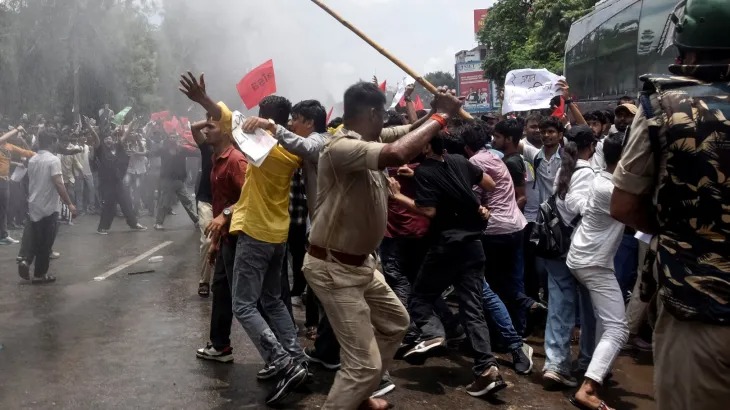

New Delhi: Indian police have been accused of using pellet guns and other increasingly violent methods to disperse student protesters in the capital, as a youth-led movement demanding education reforms and the resignation of Union Education Minister Dharmendra Pradhan continues to grow .
The allegations stem from a July 20 “Chalo Sansad” (March to Parliament) protest organised by the Cockroach Janta Party (CJP), a youth-led movement that began as an online satire but has rapidly evolved into one of the most significant challenges to Prime Minister Narendra Modi’s government .
Protesters Allege Pellet Gun Use, Police Deny
Tens of thousands of protesters gathered at Jantar Mantar in central Delhi on July 20, demanding accountability over alleged irregularities in the NEET-UG medical entrance examination—which affected some 2 million students—and the resignation of Education Minister Dharmendra Pradhan .
As protesters attempted to march towards Parliament, Delhi Police blocked their path with barricades, leading to clashes. Protesters allege police used lathi charges, tear gas, and pellet guns to disperse the crowd . Videos circulating on social media show police dragging and assaulting demonstrators .
Delhi Police have denied the allegations, calling reports of pellet gun and shock baton use “false and misleading” . The force maintains it used only standard crowd-control measures and has in turn accused protesters of displaying “unruly, aggressive and violent behaviour” and attacking personnel with stones .
Protester’s Surgery Revives Pellet Gun Debate
However, a 25-year-old protester’s account has cast doubt on the police denial. Shaikh Irshad Mansoori, a Gurugram-based employee, told Outlook India that he underwent emergency surgery after doctors removed multiple pellets from his face, neck, and near his eye .
“Doctors told me these were pellets… One pellet was lodged in my neck, very close to a major nerve and a blood vessel. Another was near the muscle that controls movement of my left eye. If it had stayed there, it could have affected my eye movement.” — Shaikh Irshad Mansoori, injured protester
Mansoori said doctors at Lady Hardinge Medical College warned that some fragments were lodged dangerously close to critical nerves and muscles, posing serious risks to his vision and facial structure . Sources at the hospital told Outlook that “over a hundred patients” were treated on July 20, and “a few did have pellet gun wounds” .
If confirmed, this would mark the first known instance of pellet guns being used against civilian protesters in Delhi .
What Are Pellet Guns and Why Are They Controversial?
The pellet guns used by Indian security forces are not air guns for sport. They are 12-gauge pump-action shotguns that fire cartridges containing around 500 to 600 small metal pellets. When fired, the pellets spread over a wide area, making it impossible to precisely target a single individual .
Pellet guns are described by authorities as “less-lethal” crowd-control weapons—introduced as an alternative to live ammunition. However, international standards prefer the term “less-lethal” precisely because such weapons can still cause serious injury, permanent disability, or death .
A History of Controversy
Pellet guns were introduced in Jammu and Kashmir in 2010 after more than 100 protesters were killed in police firing. Their use expanded significantly during the 2016 unrest, when hundreds of civilians suffered pellet injuries, many involving the eyes, with several people permanently losing their vision .
Human rights organisations have repeatedly criticised the weapons. Amnesty International has documented cases where metal pellets caused permanent blindness, facial disfigurement, skull fractures, and life-threatening injuries . The UN Office of the High Commissioner for Human Rights described the 12-gauge pump-action shotgun as “one of the most dangerous weapons used in Kashmir” .
In 2016, the Union government constituted an Expert Committee to explore alternatives to pellet guns. The government later told Parliament that security forces should first use alternatives such as PAVA (chilli) shells and grenades, STUN-LAC shells, and tear smoke shells—and only use pellet guns as a last resort . In 2018, the government confirmed that 17 protesters were killed by pellet guns in Jammu and Kashmir during 2016-2017, but declined to provide further details .
Crackdown Escalates
The July 20 protest and the alleged use of pellet guns have intensified the movement. Key developments include:
- 118 police personnel and 60 protesters reportedly injured in the clashes .
- The SFI (Students’ Federation of India) condemned the police action and announced a nationwide student strike on July 24 .
- 20 CRPF companies have been airlifted from Bengal to Delhi to bolster security .
- 16 Delhi Metro stations near the protest site have been shut .
- Protests have spread to Mumbai, Bengaluru, Kolkata, Goa, Guwahati, Jammu, and Ahmedabad .
Human Rights Concerns and Political Fallout
Amnesty International India condemned the crackdown, stating that the police “reportedly used unnecessary and excessive force against peaceful protesters” and calling for independent investigations into allegations of unlawful conduct .
Opposition parties, led by the Congress party, have seized on the issue. Leader of Opposition Rahul Gandhi and several MPs met Lok Sabha Speaker Om Birla, demanding a detailed discussion on police brutality . Gandhi was also detained after leading a sit-in protest near Prime Minister Modi’s residence .
In his first response to the protests, Prime Minister Narendra Modi announced on July 23 that fast-track courts would be set up to ensure “swift and stringent punishment” for those involved in paper leaks . Education Minister Dharmendra Pradhan has offered to debate the issue and promised exam reforms, but protesters remain at Jantar Mantar, stating his resignation is “non-negotiable” .
📊 Key Details at a Glance
| Category | Details |
|---|---|
| Protest Date | July 20, 2026 |
| Location | Jantar Mantar, New Delhi |
| Organiser | Cockroach Janta Party (CJP) |
| Demands | Resignation of Education Minister Dharmendra Pradhan; compensation for students affected by exam leaks; withdrawal of FIRs against peaceful protesters |
| Trigger | Alleged NEET-UG exam paper leak affecting ~2 million students |
| Reported Injuries | 118 police personnel; 60 protesters (official); over 100 treated at hospitals (unofficial) |
| Weapons Allegedly Used | Lathi charge, tear gas, pellet guns, shock batons |
| Medical Evidence | Protester Shaikh Irshad Mansoori underwent surgery to remove pellets from face, neck, and near eye |
| Police Response | Denied pellet gun and shock baton use; labelled allegations “false and misleading” |
| Government Response | PM Modi announced fast-track courts for paper leak cases; police deny excessive force |
Sources: Outlook India, The News Minute, BBC, Reuters, ANI, Amnesty International, ThePrint, The Telegraph, Khaleej Times