
Cockroach Janata Party: From Insult to Internet Revolution
A Chief Justice's controversial remark sparked a satirical political movement that has now overtaken the ruling BJP on Instagram and mobilized millions of young Indians.
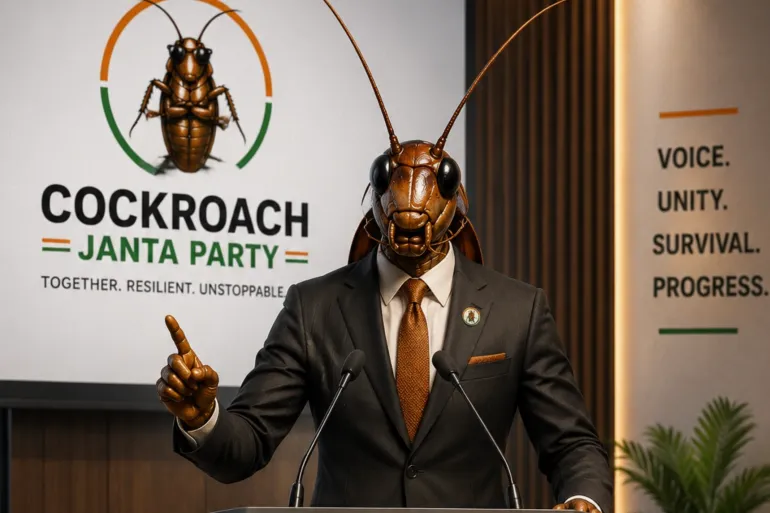

The Birth of a Movement: How It All Started
The Cockroach Janata Party (CJP) was born not from a political rally or a policy debate, but from a single controversial remark that touched a raw nerve among India’s youth.
On May 15, 2026, India’s Chief Justice of the Supreme Court, Surya Kant, made a statement during an open court hearing that would unintentionally launch a political phenomenon. While hearing a case, he reportedly said:
“There are youngsters like cockroaches who do not get any employment… some of them become media, some become social media, some RTI activists, and they start attacking everyone.”
The remarks spread rapidly across social media. Young Indians, already frustrated by soaring unemployment, inflation, and what they see as a lack of opportunities, reacted with outrage. (The unemployment rate among Indian graduates stands at a staggering 29.1 percent—nine times higher than for those who never attended school.)
The Chief Justice later clarified that his comments were taken out of context—he claimed he was referring specifically to people entering professions with fake or bogus degrees, not all unemployed youth. But by then, the damage was done. The insult had already been embraced.
The Founder: Abhijeet Dipke
Enter Abhijeet Dipke, a 30-year-old Indian student pursuing a master’s degree in public relations at Boston University. A native of Chhatrapati Sambhajinagar, Maharashtra, Dipke had previously studied journalism in Pune before moving to the United States.
On May 16, just one day after the Chief Justice’s remarks, Dipke posted on X (formerly Twitter):
The post went viral. What began as a spontaneous joke quickly took on a life of its own. Dipke followed up by announcing the formation of the Cockroach Janata Party—a name deliberately playing on the ruling Bharatiya Janata Party (BJP). He posted a Google Form for membership, listing the eligibility criteria with unmistakable sarcasm:
Within hours, 15,000 people signed up.
Dipke later told Al Jazeera that he built the party’s website and branding within 24 hours using AI tools like ChatGPT and Claude. “It was completely impromptu,” he said. “I read the CJI’s comment and I tweeted from my personal account.”
From Satire to Movement: The Numbers
What started as an internet joke has grown into something far more significant. The numbers speak for themselves:
| Metric | Figure |
|---|---|
| Instagram Followers (May 20-21) | Over 10.8 million |
| Party Membership Sign-ups | Over 350,000 (and counting) |
| X (Twitter) Followers | Nearly 62,000 |
| Youth Join Claim (May 19) | Over 40,000 |
By May 20, 2026—just five days after the Chief Justice’s remark—the Cockroach Janata Party’s Instagram account had surpassed the Bharatiya Janata Party in followers, with 10.8 million compared to the BJP’s 8.7 million.
“I can’t tell you how happy I am today. We are just hours away from overtaking the world’s largest party on Instagram. You are about to make history.”
— Abhijeet Dipke, in a video post on May 20
The Manifesto: Jokes Wrapped in Serious Demands
Despite its humorous origins, the Cockroach Janata Party has published a five-point manifesto addressing real grievances:
- Judicial Accountability: No Chief Justice should receive a Rajya Sabha seat as a post-retirement reward—a practice long criticized as a “quiet reward for judicial accommodation.”
- Women’s Representation: 50 percent reservation for women in Parliament without increasing the total number of seats, and 50 percent women in the Cabinet.
- Anti-Defection Law: A 20-year election ban on any MLA or MP who defects from one party to another.
- Media Reform: All media outlets owned by corporate conglomerates should have their licenses revoked, and their financial flows investigated to make way for genuine independent media.
- Student Issues: The CBSE should scrap rechecking fees (“blatant corruption”), and students affected by exam paper leaks (including the NEET controversy) should receive justice.
The party describes itself on its website with equal parts sincerity and irony: “Secular, Socialist, Democratic, Lazy.” Its headquarters is listed as “wherever the wifi works.”
Not Just Students: Politicians Join the “Cockroach” Movement
What transformed CJP from an online joke into a genuine political talking point was when actual elected representatives began expressing interest in joining.
- Kirti Azad, a former parliamentarian and 1983 World Cup-winning cricketer, was among the first to inquire about membership. The party responded with characteristic wit: “Winning the 1983 World Cup is a good enough qualification.”
- Mahua Moitra, a sitting Trinamool Congress MP, reposted a party message and declared herself a “card-carrying member.” The CJP welcomed her as “the fighter democracy needs.”
- Ashish Joshi, a retired federal bureaucrat, was among the earliest sign-ups, telling Al Jazeera: “In the last decade, there has been a lot of fear in the country. And people are scared to speak. The Cockroach Janata Party is like a breath of fresh air.”
Why “Cockroach”? The Deeper Meaning
The choice of “cockroach” as a political symbol is not accidental. As Dipke told Al Jazeera:
“Those in power think citizens are cockroaches and parasites. They should know that cockroaches breed in rotten places. That’s what India is today.”
The cockroach, as any biologist will confirm, is among the most resilient creatures on the planet. It has outlasted dinosaurs, adapted to every environment, and survived conditions that would destroy almost anything else.
“Cockroaches are resilient insects; they survive. And apparently they can form a party and crawl over your system.”
— Ashish Joshi, retired bureaucrat
This symbolism has resonated deeply with a generation that feels ignored, dismissed, and left behind.
The Political Context: Why This Is Happening Now
The rise of the Cockroach Janata Party cannot be understood without examining the wider context of India today:
- Youth unemployment among graduates stands at 29.1 percent—the highest in decades.
- Income inequality has ballooned, with critics pointing to the concentration of wealth among crony capitalists. Rights activist and Supreme Court lawyer Prashant Bhushan told Al Jazeera: “India’s economy and society are bleeding for the benefit of crony capitalists like Ambani and Adani.”
- Examination scandals have eroded trust. The same week as the Chief Justice’s remarks, nationwide protests erupted over exam paper leaks, forcing the cancellation of a government-run medical entrance test.
- Fear of speaking out has grown, with critics pointing to government crackdowns on dissent and a largely pliant corporate media.
Bhushan, who said he would have joined the party himself but is ineligible (he is neither unemployed nor lazy), added:
“Chief Justice’s comments reflected deep-rooted prejudice and antipathy towards activists and youth in general. This is also precisely the mentality of this present government.”
Hacking Attempts and Political Pushback
As the movement grew, so did efforts to stop it. Dipke and other party members reported multiple attempts to hack into the party’s Instagram account.
In response, Dipke posted a reel accusing a “vishwaguru” (global leader)—a term often used by Prime Minister Narendra Modi to describe India under BJP rule—of getting scared of 20 to 21-year-olds. Another post about the hacking attempts carried the caption: “BJP scared of cockroaches?”
The BJP has not yet issued an official response to the formation or rise of the Cockroach Janata Party.
“No Longer a Satire”: What Comes Next?
Despite its satirical origins, Dipke insists that the movement is evolving into something serious.
“Let me make this absolutely clear. Do not insult or underestimate the Gen Z of India… The youth of this country are far more mature, aware, and politically conscious than many give them credit for. They understand their constitutional rights and will express their dissent through peaceful and democratic means.”
— Abhijeet Dipke
In an interview with DW, Dipke elaborated:
“It’s no longer a satire or a joke. It’s getting pretty serious… There is an outlet for our anger. I think it’s more about the complete political scenario, the complete political situation where people all these years were scared to speak against the power. And now they finally have found an outlet.”
The party has announced plans for its first virtual Gen-Z convention—an online space for young people to organize, discuss, and campaign.
However, as of now, the Cockroach Janata Party remains unofficial. It has not yet registered with the Election Commission of India. Whether it ever files papers, fields candidates, or grows beyond its current life as a highly successful piece of political performance art remains an open question.
A Pattern in South Asia: Gen-Z Political Movements
The Cockroach Janata Party is not an isolated phenomenon. In recent years, South Asia has witnessed historic Gen-Z protests that have toppled governments in neighboring countries:
- Sri Lanka (2022): Youth-led protests forced President Gotabaya Rajapaksa to flee the country and resign.
- Nepal (2023): Mass protests reshaped the political landscape.
- Bangladesh (2024): Student demonstrations led to the fall of Prime Minister Sheikh Hasina’s government.
India, the world’s most populous nation with the largest Gen-Z cohort on the planet, has been watching.
Meghnad S, a YouTuber who hosted Dipke for a stream on the newly launched party, told Al Jazeera:
“There is an overwhelming sense that people are looking for alternative political formations, not necessarily political parties, but political experiments that are not traditional. Cockroach Janata Party is a satirical, non-existent party, yet people believe that it is a better alternative to reality. That’s kind of a giant commentary on Indian political parties in general.”
The Bigger Question: Can a Joke Change Politics?
The Cockroach Janata Party occupies a strange space—neither fully real nor fully fake. It is a protest wrapped in irony, a political party that doesn’t exist but has millions of followers.
Whether it will translate into actual electoral power remains to be seen. But as Dipke himself noted, for too long, people have been quiet in India. The fact that millions have now declared themselves “cockroaches” suggests that something has fundamentally shifted.
“People are finally asking questions and demanding accountability.”
— Prashant Bhushan
The cockroach, as it turns out, is not so easily crushed.
Sources: Al Jazeera, Deutsche Welle (DW), The Statesman, ThePrint, China Press, Mashable India, O Heraldo, The Shillong Times.
Correction Note: Some headlines have referred to the party as “Cockroach Janta Party” (with an alternative spelling). Both refer to the same entity.