
The History We Must Not Forget
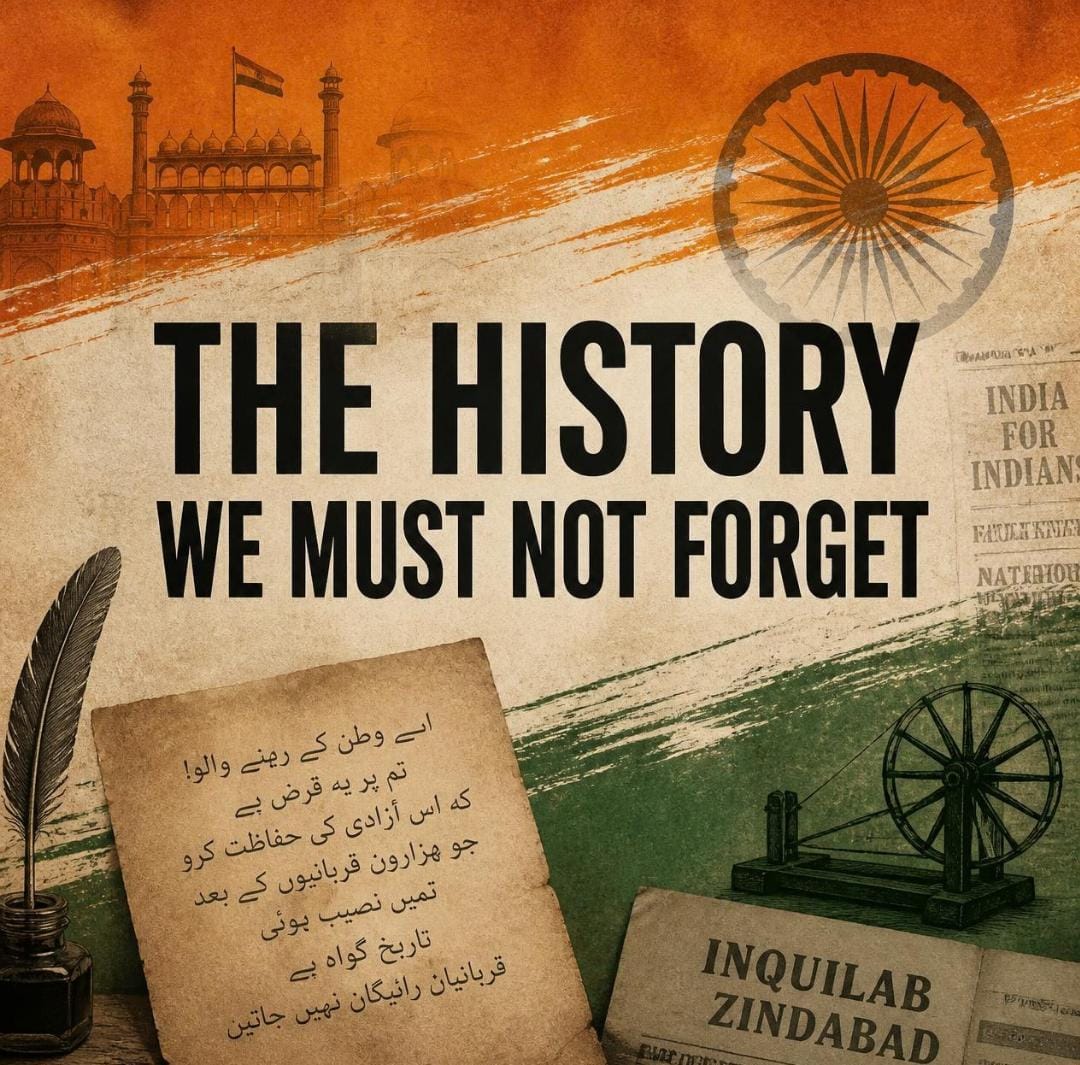

Remembering the Muslim Builders of India
There are histories that do not disappear because they were never lived.
They disappear because, with time, fewer people remember them.
Perhaps that is one of the quietest tragedies a people can face – to inherit a history rich with sacrifice, courage and contribution, and yet grow distant from the very people who shaped it.
Today, our connection with the past often feels increasingly fragile.
The stories of those who came before us, the sacrifices they made, and the lives they devoted to this land can become distant memories, reduced to a few scattered names and forgotten pages.
And sometimes, the greater tragedy is that we begin to see our own history through the eyes of others, measuring our past by standards that were never meant to define it.
For generations, countless Muslims have been an inseparable part of the history of India.
They contributed to its intellectual, cultural, social and political life, and many stood at the forefront of struggles for justice and freedom.
Yet so many of their stories remain unfamiliar to the younger generation.
When the names of our forefathers disappear from memory, more than history is lost.
A connection is lost.
A sense of belonging is lost.
A piece of our collective memory quietly disappears.
This is why these stories must be brought back into the light.
Not to diminish the contribution of anyone else, nor to replace one version of history with another, but simply to tell India’s story in its fullness – with all the people, communities and sacrifices that helped shape it.
Hazrat Maulana Syed Abul Hasan Ali Nadwi (RA), while reflecting upon the history and contributions of Muslims in India, emphasized the importance of remembering those who had given their lives, efforts and sacrifices to the land they called home.
And perhaps that is something worth remembering today: the Muslims of India did not merely exist upon this soil.
They became a part of its story.
They contributed to its learning, its culture, its institutions and its struggles.
Many stood alongside others in the fight for freedom and justice, while some gave everything they had in the service of the country.
Their relationship with India was not merely a matter of geography.
It was a matter of belonging.
This was the land where they were born.
The land where their families lived.
The land where their hopes were built.
The land where their ancestors were laid to rest.
India was not simply a country on a map.
For them, it was home.
And perhaps that is why remembering their contribution matters so much.
There is a beautiful sentiment in the words attributed to this tradition of thought – a prayer that the homeland may remain prosperous and flourishing, and that the beloved country may remain peaceful and happy.
There is something deeply meaningful in that sentiment.
Love for a homeland does not belong to one community alone.
It can live in different hearts, speak through different languages and emerge from histories that are not identical, yet all belong to the same land.
But there is an uncomfortable truth we must also acknowledge.
When certain chapters of history are repeatedly overlooked, eventually an entire generation may grow up believing those chapters were never written at all.
Instead of preserving the flowers of our shared history, we sometimes find ourselves caught among its thorns – tearing away pages, leaving gaps behind, and allowing silence to take the place of stories that deserved to be remembered.
That is why remembering is not simply nostalgia.
It is a responsibility.
Our educational and historical narratives should have room for the people who helped shape India – the celebrated and the forgotten, the ancient and the modern, and people belonging to every community that contributed to the making of this country.
Young people deserve to know the lives of those who stood for something greater than themselves.
They deserve to inherit stories of courage, sacrifice, knowledge, faith, resilience and service.
And among those stories must be the stories of Indian Muslims who took part in the struggle for freedom and contributed to the making of the nation.
Not because their contribution needs to be exaggerated.
But because it deserves to be remembered.
There is a particular sadness in turning page after page of history, searching for the people who came before you, only to find that their presence has somehow been reduced to silence.
ورق ورق الٹ چکا تلاش میں کمی نہ کی
مگر کتابِ حیرت میں میری داستان نہیں
I turned through page after page, leaving no part of the search unfinished,
Yet, in the wondrous book, I could find no trace of my story.
To search for yourself in the history of your own homeland and find only silence is a feeling no community should have to inherit.
Yet remembering this history need not create division.
Perhaps it can do the opposite.
Because a nation becomes richer when its history is broad enough to hold the stories of everyone who helped build it.
India’s story was never written by one hand alone.
Its soil carries the footsteps of generations.
Its cities, languages, literature, architecture, institutions, movements and memories have been shaped by people of different faiths, backgrounds and traditions.
Recognizing one community’s contribution does not take away from another’s.
We do not need to compete over who belongs more.
We simply need to remember who helped build what we have inherited.
Every generation receives a country shaped, in some way, by those who came before it.
The least we can do is learn their names, understand their struggles, acknowledge their sacrifices and pass their stories forward with honesty.
Because when history is forgotten, it is not only the past that suffers.
The future does too.
Perhaps the greatest tribute we can offer those who came before us is not merely to remember that they once lived, but to understand what they stood for – and to ensure that their courage, their sacrifices and their contributions to this land are never reduced to a forgotten footnote.
A nation’s history belongs to everyone who helped write it.
And the pages written through sacrifice, courage, love and struggle should never be allowed to disappear.
(This article is adapted from the book Tahrik-e-Azadi Mein Ulama Ka Kirdar by Faisal Ahmad Bhatkali Nadwi and translated by Shaimaa Peshimam.)