
The AI Challenge: Ensuring India’s Future Is Shared, Not Divided
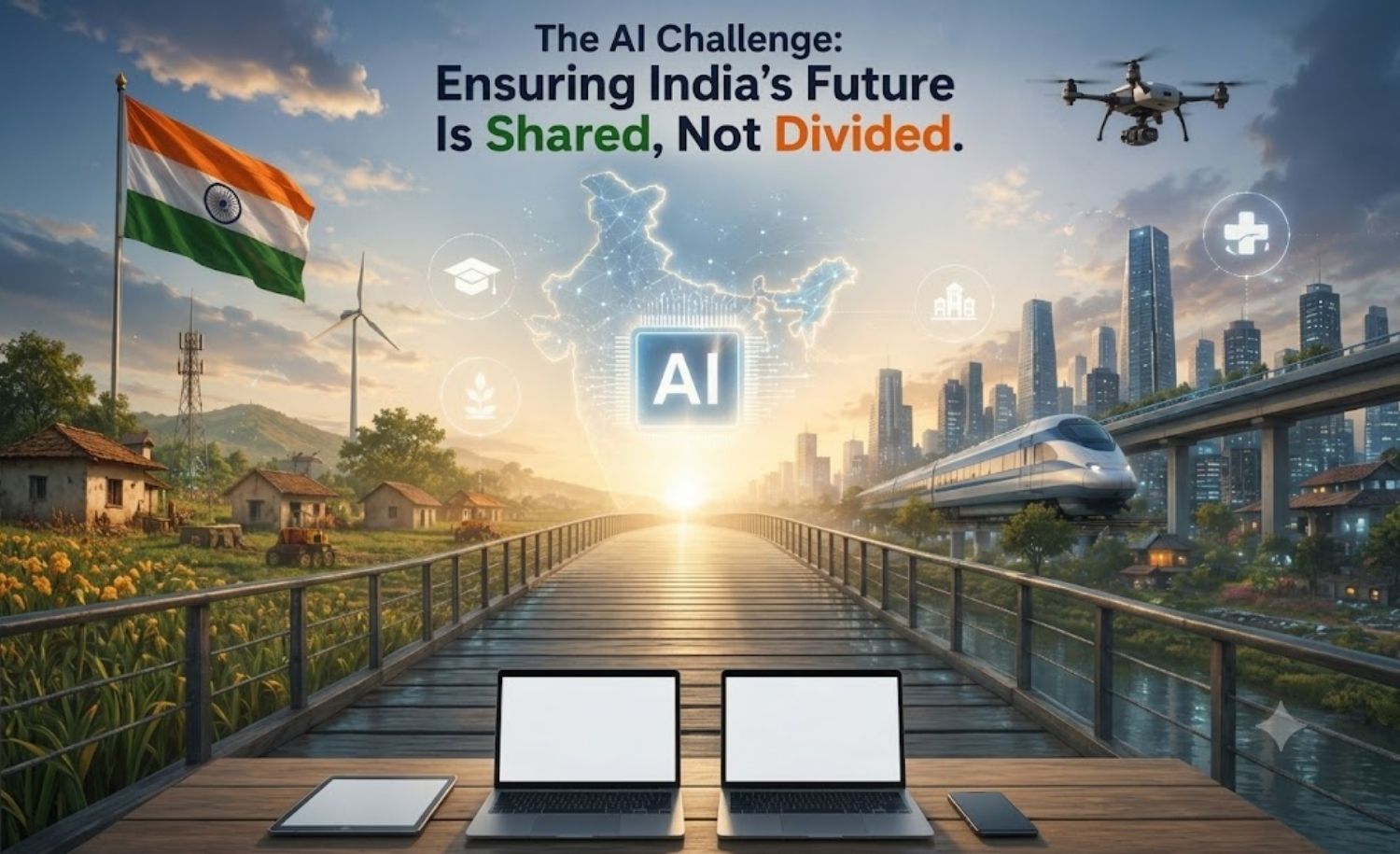

NEW DELHI: By the end of 2030, artificial intelligence(AI) will touch almost every part of our lives – how we learn, work, access public services and how businesses make decisions. The global race for AI leadership is underway: the United States and China are pouring billions into research, innovation and digital infrastructure. For India, with the world’s largest youth population, AI presents a once-in-a-generation opportunity – and a serious test.
The popular question – will machines take our jobs? -misses the point. Technology has historically destroyed some occupations while creating new industries and livelihoods. The Industrial Revolution displaced many traditional trades but also spawned mass employment in manufacturing and services. The digital revolution automated clerical tasks but gave rise to an IT sector that employs millions of Indians today.
AI will follow a similar pattern, but faster and broader. Modern systems can now execute tasks once seen as uniquely human – writing, translation, coding, customer service and data analysis. The pace and scale of this change may outstrip the ability of labour markets to adjust.
For India, the stakes are high. Each year millions of young people enter the workforce, while unemployment and underemployment persist. A large share of India’s labour force works in low-skill, informal roles that are especially vulnerable to automation.
Yet, treating AI only as a threat would be a mistake. India has real strengths: a thriving tech ecosystem, a deep well of engineering talent, an energetic start-up culture and an impressive digital public infrastructure capable of delivering services at scale. These assets could help India become an AI leader rather than a passive consumer of foreign technologies.
There is also a geopolitical dimension: countries that lead in AI will shape global standards, economic competitiveness and national security. India must invest in indigenous research and nurture home-grown innovation to preserve technological sovereignty and long-term resilience.
The core challenge is not resisting technology but preparing society for it. India’s education system remains heavily exam-oriented and rote-based, while the AI era will reward creativity, critical thinking and complex problem-solving.
A comprehensive national strategy is urgently needed
Scale up skills development. Treat digital literacy as basic as reading and writing. Expand training in AI, machine learning, data science and cybersecurity while strengthening human skills – communication, adaptability and leadership.
Support innovation and entrepreneurship. Small and medium enterprises, which employ large numbers of workers, often lack resources to adopt advanced tech. Public incentives, affordable digital infrastructure and targeted training can help them modernize without sacrificing jobs.
Build ethical and regulatory guardrails. AI raises real risks – privacy violations, misinformation, algorithmic bias and accountability gaps. Robust rules and oversight are essential to prevent new forms of exclusion and inequality.
Use AI for inclusive development. Deployed well, AI can expand healthcare access in underserved areas, boost agricultural productivity through precision farming, improve educational outcomes and make public services more efficient – helping bridge long-standing gaps.
India stands at a crossroads: remain a consumer of externally developed tools, or become a global leader that harnesses AI for inclusive growth. That choice will not be decided by machines but by policy, institutions and societal will.
AI is neither saviour nor scourge. It is a powerful tool whose outcomes will be determined by human choices. For a young nation aiming to become a developed economy, the question is settled: AI is already transforming India. The urgent task is to ensure this transformation widens opportunity rather than concentrates prosperity in the hands of a few.
About the author: Tanveer Alam is a Delhi-based independent journalist, writer, poet and commentator on democracy, education, technology, youth and inclusive development in India. He contributes essays and literary pieces to newspapers, magazines and digital platforms.