
Remembering Our First Education Minister: Maulana Abul Kalam Azad
A visionary scholar who built the foundation of modern education in independent India.
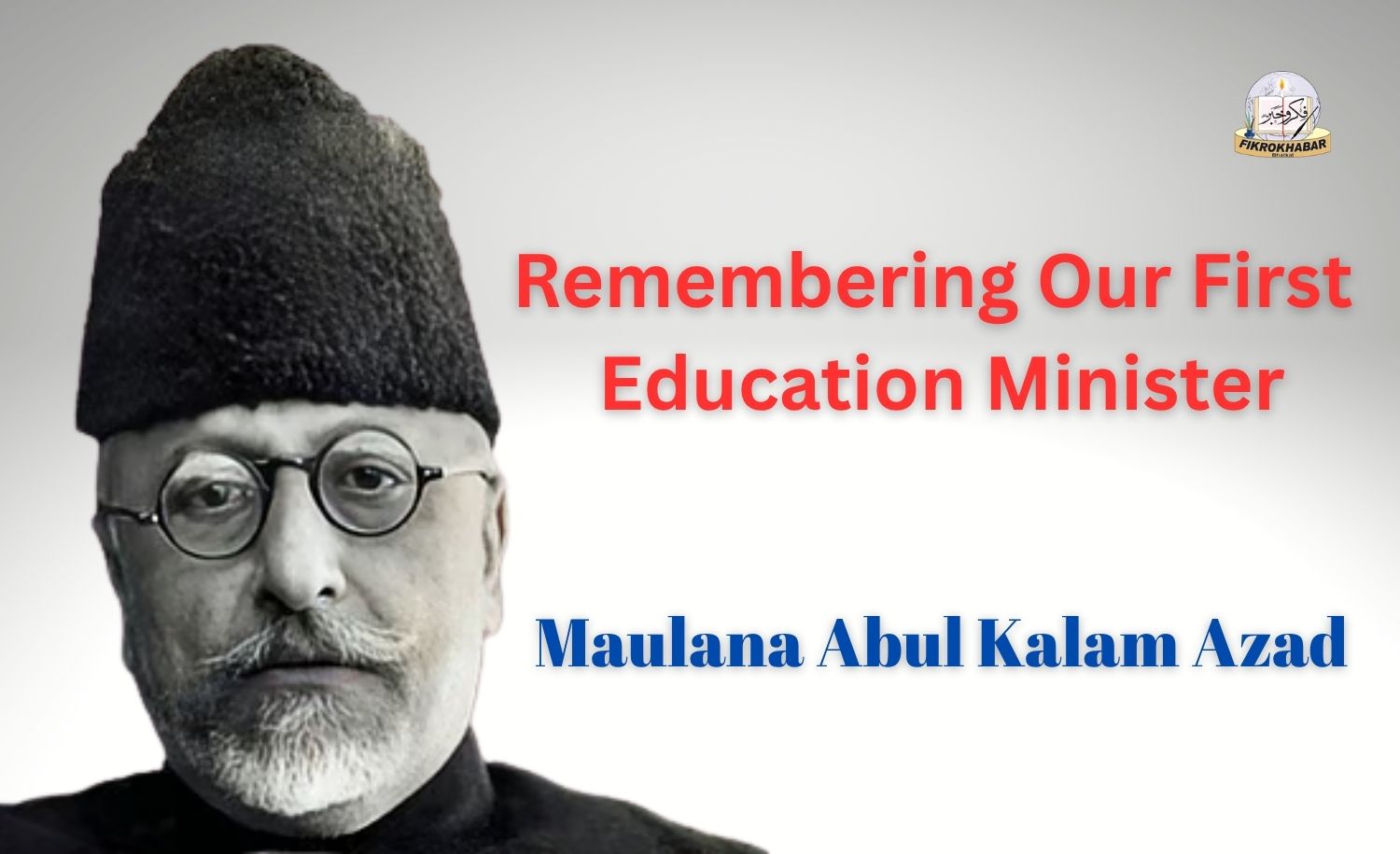

Maulana Abul Kalam Azad was one of the greatest sons of India, a freedom fighter, scholar, writer, journalist, and above all, the architect of modern Indian education. His name stands among those who not only fought for India’s independence but also envisioned a free and educated nation where knowledge would empower every citizen.
Born on 11 November 1888 in Mecca, then part of the Ottoman Empire, Azad’s real name was Abul Kalam Ghulam Muhiyuddin. His family moved to Calcutta (now Kolkata) when he was just two years old. Coming from a lineage of Islamic scholars, Azad was introduced to the world of learning at a very young age. His father, Maulana Khairuddin, was a respected theologian, and his mother came from a family of renowned scholars in Medina.
At home, young Azad received traditional Islamic education learning Arabic, Persian, and Urdu, along with theology, philosophy, and logic. However, what made him different was his curiosity beyond the traditional curriculum. Through self-study, he mastered English, world history, mathematics, and science. By the age of 12, he was running his own library and a debating club. By 15, he was already teaching students older than himself a sign of the brilliance that would define his life.
The Journalist and Thinker
Azad’s sharp intellect and fearless spirit found expression through journalism. At just 11, he began writing poetry and essays. In 1912, he launched the Urdu weekly Al-Hilal in Calcutta. Through its pages, Azad spoke boldly against British rule and encouraged young Muslims to join India’s struggle for freedom. His writings also promoted Hindu-Muslim unity — a cause he championed throughout his life.
The British government, alarmed by his growing influence, banned Al-Hilal in 1914. Undeterred, Azad started another weekly, Al-Balagh, which continued to spread his message of nationalism and unity. This, too, was banned in 1916, and Azad was placed under house arrest in Ranchi until 1920. Even in confinement, he remained devoted to his cause and his pen never stopped challenging injustice.
The Revolutionary Nationalist
Azad was inspired by revolutionary ideas during his travels to Egypt, Syria, Iraq, and Turkey, where he met political reformers and freedom fighters. Their courage strengthened his resolve to fight colonial rule in India.
He opposed the partition of Bengal in 1905 and rejected communal politics that sought to divide Indians by religion. His thoughts were deeply influenced by the reformist ideas of Jamaluddin Afghani and Sir Syed Ahmed Khan, but he went beyond them by blending Islamic principles with modern, rational thinking.
When he returned to India, Azad became an important voice in the Indian freedom movement. He supported Mahatma Gandhi’s call for Non-Cooperation and Khilafat Movements and joined the Indian National Congress in 1920. His passion and leadership made him the youngest person ever elected President of the Congress at the age of 35 in 1923.
A Voice for Unity and Secularism
Throughout his life, Maulana Azad stood firmly for the idea of a united and secular India. He rejected the Two-Nation Theory proposed by Muhammad Ali Jinnah, believing that Hindus and Muslims had shared the same soil, culture, and history for centuries.
He once said:
“I am proud of being an Indian. I am part of the indivisible unity that is Indian nationality. Without me this splendid structure is incomplete.”
As Congress President again from 1940 to 1946, Azad guided the party through some of the toughest years including the Quit India Movement and the tragic events leading to Partition. Despite his strong opposition, he witnessed the division of the country in 1947, a moment that deeply pained him. Yet, even after independence, he worked tirelessly to protect the rights and dignity of Muslims who chose to remain in India.
The Architect of Modern Indian Education
After independence, Maulana Abul Kalam Azad became India’s first Minister of Education in Prime Minister Jawaharlal Nehru’s cabinet. This role allowed him to put his lifelong vision into action — to build a nation where education was accessible to all.
Azad firmly believed that education was the birthright of every citizen. Under his leadership, India adopted policies for free and compulsory primary education for all children up to the age of 14. He placed special emphasis on girls’ education and adult literacy, realizing that no country could progress if half its population remained uneducated.
During his tenure, several key educational and cultural institutions were established, including:
- The University Grants Commission (UGC)
- The Indian Institutes of Technology (IITs)
- The Indian Institute of Science (IISc)
- The Jamia Millia Islamia University
- The Sahitya Akademi, Lalit Kala Akademi, and Sangeet Natak Akademi
- The Indian Council for Cultural Relations (ICCR)
Azad also presided over the UNESCO General Conference in 1956, bringing international recognition to India’s commitment to education and culture.
A Man of Letters and Faith
Beyond politics, Maulana Azad was a gifted writer and philosopher. His literary works, such as India Wins Freedom, Ghubar-e-Khatir, and Tarjuman-ul-Quran, showcase his deep intellect and spiritual insight. While India Wins Freedom gives a detailed account of India’s independence movement, Ghubar-e-Khatir reflects his philosophical reflections written during imprisonment.
Azad believed in blending modern scientific knowledge with traditional moral education. To him, education was not just about literacy, but about building character and nurturing a sense of national responsibility.
Final Years and Legacy
Maulana Abul Kalam Azad served as Education Minister until his death on 22 February 1958. His passing marked the end of an era — that of a scholar-statesman who lived for his ideals of knowledge, unity, and peace.
In recognition of his unmatched contribution, the Government of India posthumously awarded him the Bharat Ratna in 1992, the nation’s highest civilian honour. Every year, 11 November, his birthday, is celebrated as National Education Day across India to remember his vision and lifelong dedication to education.
Why We Remember Him
Maulana Azad’s legacy is not limited to his role as a freedom fighter or minister. He was a bridge between tradition and modernity, between faith and reason, between communities divided by politics. His life continues to remind us that true patriotism lies in education, tolerance, and unity.
Even decades after his death, his ideas remain alive in every classroom, every university, and every student who dreams of learning and building a better India.