Muslims’ Role in India’s Freedom Struggle: A Historical Journey Often Overlooked
From medieval rulers to independence fighters, the Muslim community's contribution to India's independence and development remains a vital yet frequently misunderstood chapter of history
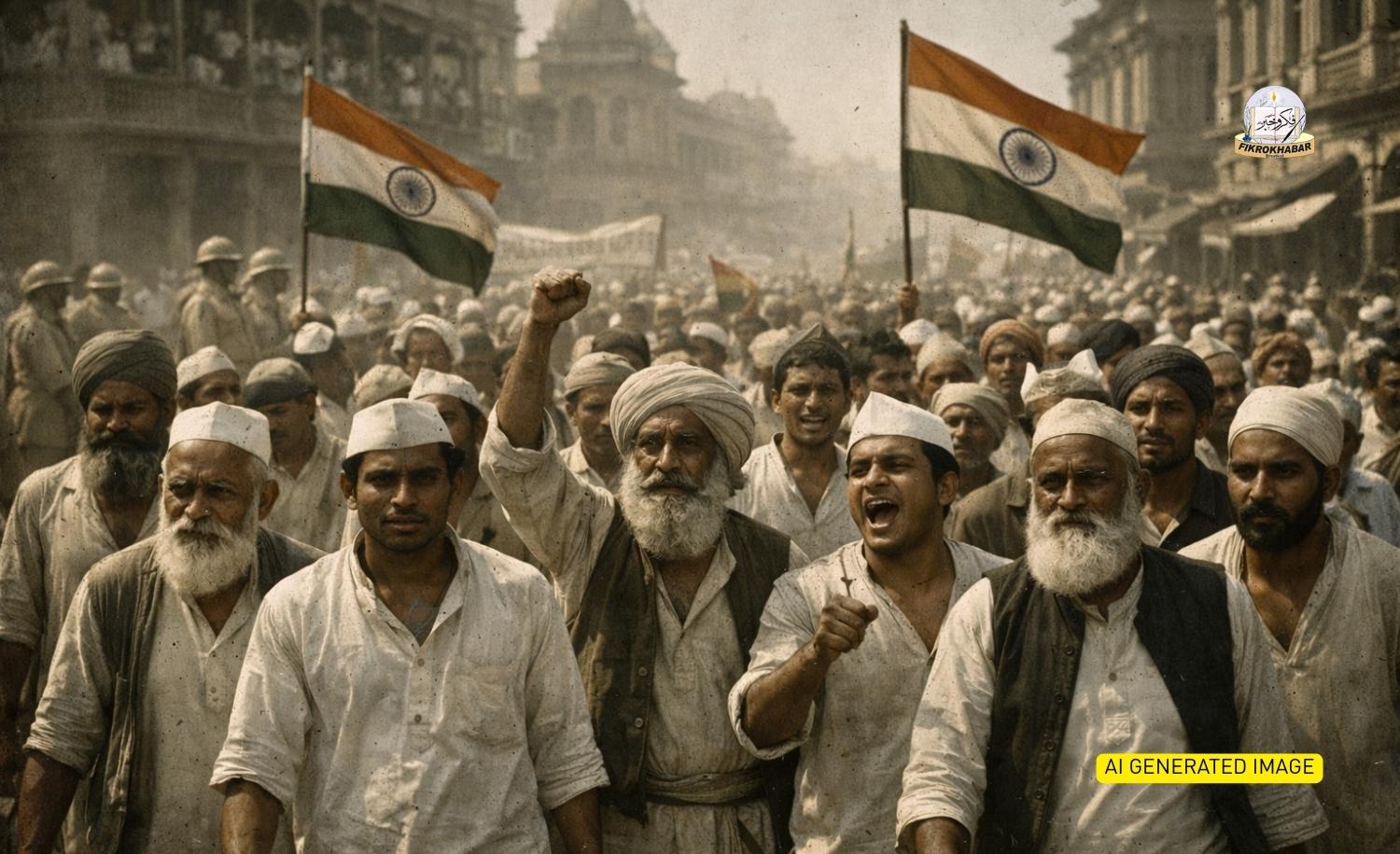

The story of India’s independence is incomplete without acknowledging the significant contributions of Muslims throughout history. From ruling the subcontinent for over a thousand years to leading the charge against British colonial rule, Muslims have played a central role in shaping modern India. However, in recent times, efforts to rewrite history have attempted to diminish or distort these contributions.
Muslim rulers governed various regions of India for more than a millennium. Unlike the British colonizers who systematically drained India’s wealth to their homeland, Muslim emperors made India their home. They invested the country’s resources back into its development, transforming India into what was famously called the “Golden Bird” (Sone Ki Chidiya) due to its immense wealth and prosperity.
These rulers showed remarkable fairness toward non-Muslim subjects. Even Aurangzeb, often portrayed negatively in modern narratives, has documented evidence of granting land and support to Hindu temples across multiple regions. Historical records show he built temples and provided protection through official decrees. The infamous temple destruction story refers to a single incident involving a site that had become a center of criminal activity, and even then, the demolition was advised by non-Muslim leaders after discovering illegal activities there.
Muslim rulers promoted what became known as the Indo-Islamic culture, blending traditions from both communities and working toward maintaining the country’s integrity and unity.
First Resistance Against British Rule
When the British began their conquest of India, Muslims were among the first to resist. Siraj-ud-Daulah fought against British forces in 1757, ultimately achieving martyrdom. Tipu Sultan battled the British until his death in 1799. When Tipu Sultan fell, a British general reportedly stood over his body and declared, “Now India is ours,” recognizing him as the greatest obstacle to their conquest.
After the British established complete control and reduced Mughal emperors to mere puppets, Shah Abdul Aziz, one of the era’s most respected Islamic scholars, issued a historic fatwa in the early 1800s. He declared that India had become “Dar-ul-Harb” (a land under hostile control) because the British had seized political, economic, and educational authority. This fatwa called for resistance against British rule, not just for Muslims but for the protection of India’s sovereignty.
Thousands of scholars sacrificed their lives following this call. Some entire regions were destroyed by bulldozers, their land flattened and converted to farmland as punishment. The town of Sadiqpur witnessed particularly brutal suppression of religious scholars who had stood against colonial rule.
The 1857 Uprising and Beyond
The 1857 revolt, which the British called a “mutiny,” was largely led by Muslims. When Bahadur Shah Zafar took command of the independence movement, both Hindus and Muslims united under his leadership. British trial records from that period explicitly state that Muslims were at the forefront of opposition, with British officials noting they could find no significant non-Muslim leadership in the rebellion.
British historian W.W. Hunter wrote in his 1881 book “The Indian Muslims” that since their arrival in India, the greatest opposition came from Muslims, and they would remain the British’s primary adversaries. He noted that when the British arrived, Muslims were the most powerful community in terms of strength, courage, education, and economy.
Regional Resistance Movements
Southern India witnessed early resistance against European colonizers. In the 16th century, Kerala saw organized jihad against the Portuguese. Scholar Zainuddin al-Malibari, a renowned expert in Shafi jurisprudence whose book “Fath al-Muin” remains a standard text in Islamic studies, wrote “Tuhfat al-Mujahidin” about four centuries ago. This work documented Portuguese atrocities against Muslims in Kerala and encouraged resistance against foreign oppression.
In Bengal, after the fall of local rulers like Siraj-ud-Daulah and Shuja-ud-Daulah, popular movements emerged. The Faraizi movement and movements led by scholars were public uprisings that included both Hindus and Muslims, though leadership remained in Muslim hands. These movements opposed both oppressive landlords (many of whom were British allies) and the British themselves.
The Shahidan Movement (Mujahideen Movement), led by Syed Ahmad Shaheed and Maulana Ismail Shaheed before 1857, spread across India. The British labeled it the “Wahhabi Movement,” though it had no connection to Wahhabism. Leaders toured the country, teaching Islam and awakening people to British exploitation and the slavery they were imposing. This movement continued even after the martyrdom of its founders, with followers spreading across different regions.
British authorities responded with extreme brutality. Entire settlements were razed to the ground, cultivated over to instill fear. Thousands were imprisoned, sent to the Andaman Islands (Kala Pani), or executed.
The Reshmi Rumaal (Silk Handkerchief) Movement
Maulana Mahmud Hasan Deobandi led the Reshmi Rumaal Movement, which included both Hindus and Muslims. Despite being a prominent hadith scholar and Sufi spiritual leader, he dedicated himself to India’s freedom. He traveled to Turkey and Arab countries, writing letters to rulers and generals seeking international support to expel the British from India.
His students were sent to Russia, Afghanistan, and other countries to build diplomatic support. Unfortunately, the movement was discovered, and Maulana Mahmud Hasan was imprisoned. His imprisonment didn’t stop his followers from continuing the struggle.
Institutional Resistance
When the British attempted to replace Indian culture and Islamic civilization with their own, educational institutions were established to counter this. Darul Uloom Deoband was founded after its founders including Haji Abdullah, Maulana Rashid Ahmad Gangohi, Maulana Qasim Nanotvi, and Hafiz Zamin Shaheed fought British forces in the Battle of Shamli.
After realizing armed resistance was difficult at that moment, they established Darul Uloom Deoband to preserve Islamic knowledge, protect Islamic culture, and prepare the younger generation to confront the British.
Similarly, Aligarh Muslim University emerged from Sir Syed Ahmad Khan’s initiative. Though his approach differed believing Muslims needed to adopt British education to survive his institution eventually produced major freedom fighters like Muhammad Ali Jauhar, Shaukat Ali, and Hakim Ajmal Khan.
Jamia Millia Islamia was established specifically to oppose British influence, particularly when Aligarh’s administration came under British control. Muhammad Ali Jauhar founded it to ensure Muslims remained self-reliant and prepared to challenge British rule.
The Power of Poetry and Media
Urdu poetry played a crucial role in awakening national consciousness. Mir Taqi Mir witnessed such bloodshed at Delhi’s Jama Masjid that his poetry became filled with pain. Mirza Ghalib wrote only 11 or 12 ghazals in the 12 years following the 1857 uprising, later explaining his heart had broken after witnessing the atrocities.
Later poets like Allama Iqbal, Shibli Nomani, Akbar Allahabadi, and Maulana Zafar Ali transformed Urdu poetry into a tool for national awakening. Their verses spread like wildfire across India, igniting the spirit of freedom.
The Muslim press also played a vital role. Many Urdu newspapers dedicated their pages to the freedom movement. When the British captured Delhi in 1857, they killed Maulana Baqir editor of the Delhi Urdu Akhbar and father of Muhammad Hussain Azad (author of “Aab-e-Hayat”) because his newspaper’s writings had inflamed public sentiment.
Later, newspapers like “Zamindar” (by Maulana Zafar Ali) and Maulana Abul Kalam Azad’s “Al-Hilal” created enormous impact. The British repeatedly banned these publications, forcing editors to change names to “Al-Balagh” and other titles. Maulana Muhammad Ali Jauhar’s English newspaper “Comrade” was so powerful that even British officers waited to read his editorials. His publication “Hamdard” similarly inspired public sentiment during the independence struggle.
Mass Participation
The freedom movement wasn’t limited to scholars and intellectuals. When the Non-Cooperation Movement called for boycotting British institutions, thousands of Muslims resigned from government jobs. When Subhas Chandra Bose formed the Indian National Army (Azad Hind Fauj), Muslims contributed millions in financial support. Officers like Major Shahnawaz Hussain faced trials in 1945 for their role in this army.
Muslim women donated their jewelry for the independence cause. Ordinary traders and businesspeople supported the movement with their wealth and resources, understanding that national freedom came before personal interests.
The Partition Tragedy
The partition of India in 1947 remains one of history’s darkest chapters. Sir Cyril Radcliffe, a British lawyer who had never visited India, was given just a few weeks to draw borders between India and Pakistan. He worked from closed rooms in Delhi with only maps, population tables, and a pencil.
Radcliffe had no idea his lines would displace 20 million people and result in hundreds of thousands of deaths. The basis was simple: Muslim-majority districts would go to Pakistan, Hindu and Sikh-majority districts would remain in India. However, cities like Lahore (with 5 lakh Hindus, 1 lakh Sikhs, and 6 lakh Muslims) presented complex challenges.
The announcement of borders on August 17, 1947 two days after independence triggered the largest human migration in history. Fifty million people found themselves on the wrong side of the border. The violence was unimaginable, with “ghost trains” arriving at stations filled with corpses rather than passengers.
While Punjab descended into chaos despite a 55,000-strong Boundary Force, Calcutta witnessed a miracle. Mahatma Gandhi stayed in Calcutta’s Beliaghata area with Shaheed Suhrawardy the very person many blamed for the Direct Action Day violence of 1946. Through Gandhi’s fast and moral authority, communal violence stopped completely. The “Miracle of Calcutta” proved that what 55,000 armed soldiers couldn’t achieve, one elderly man armed only with non-violence could accomplish.
Legacy Under Threat
Today, when Muslims are asked to prove their patriotism and loyalty to India, it represents a profound injustice. The very people whose ancestors led independence movements are now questioned about their commitment to the nation.
The real tragedy isn’t just that history is being distorted by those in power. The greater problem is that Muslims themselves have become disconnected from their own history. Ask young Muslims today about their community’s role in India’s independence or development, and most cannot provide accurate answers.
A Call to Remember
Religious scholars, educators, and community leaders emphasize the urgent need to revive this historical knowledge. Young Muslims must learn about the sacrifices of their ancestors the scholars who gave their lives, the poets who awakened national consciousness, the journalists who faced imprisonment, and ordinary people who sacrificed everything for India’s freedom.
Self-confidence comes from knowing one’s history. When people are disconnected from their past, they lose the courage and determination that defined their ancestors. Educational curricula, family discussions, and community programs must prioritize teaching this history to ensure future generations understand their heritage and can live with dignity and confidence.
The struggle isn’t just about correcting historical narratives. It’s about ensuring that the contributions of millions are neither forgotten nor erased, and that the true story of India’s independence including the central role Muslims played is preserved for future generations.
Source: This article is based on speeches by Maulana Abdul Aleem Nadwi delivered at Jamia Masjid, Bhatkal, and incorporates historical analysis from various documented sources on India’s independence movement.