
How a generation of young Indians is testing the limits of democracy

India’s democracy is facing its biggest test in years. Its signals are worth watching at a time of democratic backsliding in so many corners of the world.
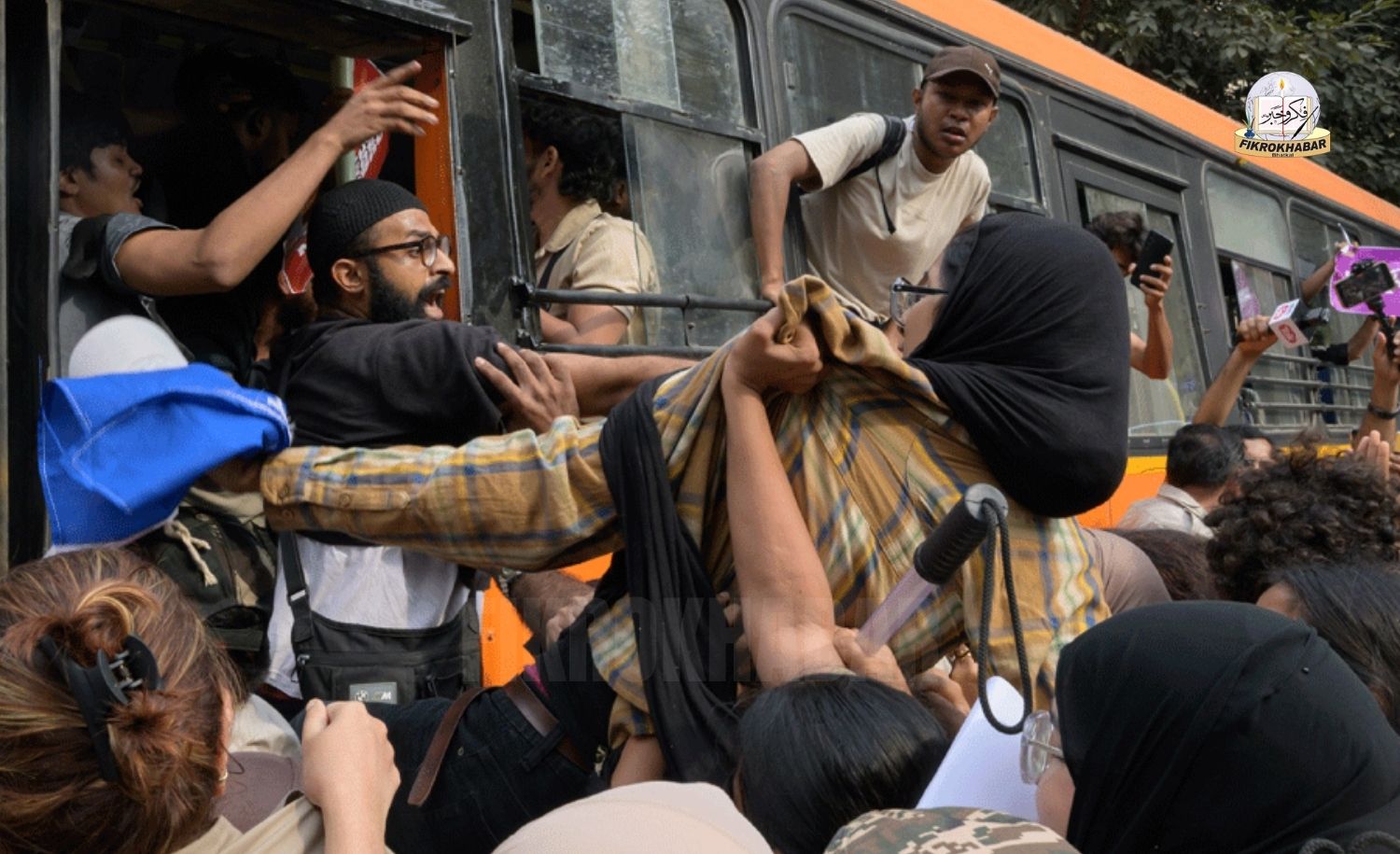
A defiant generation of young Indians has poured into the streets on and off for the past four months — first over education, then over voting rights. They did so at a time when dissent was all but crushed by Prime Minister Narendra Modi’s near-total hold on power, confronting the government over some of the most fundamental principles of democracy: the right to vote, the right to ask questions of those in power and the right to protest. They were irreverent and funny, and they appealed to India’s prized tradition of democracy — some waving the national flag as they were hauled away by police.
For now, at least, their street revolt has ebbed, in part due to an extraordinary show of force by state security organs. Still, after more than a decade of democratic backsliding in India, the protesters’ defiance has broken the dam, unleashing the hopes and fury of a generation in the world’s largest democracy.
“The fear needs to go,” Gul Kumaria, 26, told me at a recent rally called by the Cockroach Janta Party, the Generation Z movement that catalyzed the youth rebellion. It was a sentiment I heard repeatedly from young Indians on the streets.
India’s youth-led protests are driven by many of the same grievances fueling demonstrations in Europe: poor schools, a paucity of jobs, a lack of government accountability, and a loss of faith in traditional institutions. But they have differed in one crucial way. They have been largely nonviolent.
Democracy means different things to different people.
Democracy can be a potent rallying cry.
Modi, speaking to an international business conference in New Delhi, the capital, in mid-October, called India “the mother of democracy.” Members of his governing Bharatiya Janata Party described opposition politicians as sore losers in democratic elections and inveighed against what they called anarchy on the streets. The defense minister, Rajnath Singh, last week accused opponents of trying to topple the government with what he called a “politics of disruption.”
The protesters swiftly responded with their own appeals to democracy.
“But demanding answers from the govt is not anarchy, protesting against injustice on the streets is not anarchy, and questioning those who hold public office is certainly not anarchy,” the Cockroach Janta Party’s 31-year-old founder, Abhijeet Dipke, retorted in a social media post. “These are the most fundamental expressions of democracy.”
Neha Bora, a leader from the youth wing of one of India’s communist parties, called the BJP “the enemy of democracy.”
Rahul Gandhi, the leader of opposition party Indian National Congress, seized on the same language. “We are fighting together to restore democratic rule, genuine democratic rule in this country,” he said, with Bora at his side. Gahdhi’s party has flailed in elections for more than a decade.
Not since Prime Minister Indira Gandhi, Gandhi’s grandmother, imposed emergency rule in June 1975 has India faced such a reckoning over its most prized tradition.
Old-school politicians play a critical role, too.
The Cockroach Janta Party energized India’s young this summer over a dysfunctional college entrance exam system. They were playful and often cocky and they used Instagram to draw in people who hadn’t been politically active before. They created what Milan Vaishnav, South Asia director at the Carnegie Endowment for International Peace, called “viral symbols of dissent.”
“Humor and satire are underrated political weapons,” he said.
Except the Cockroach Janta Party lacked the organizing skills of India’s robust leftist student movements. They called protests only to get locked up before they could lead them, which is when young communists like Bora stepped up. They organized pop-up protests. They gave the police the runaround. They held on to one another so tightly it was hard for police to pry them apart. They sprinted from security forces, jumped over barricades and crawled out of police bus windows.
Together, the new protesters and the more experienced communists created an opening that the established opposition parties had not had in over a decade.
Only after the youth took to the streets did the Congress party — founded more than 140 years ago to oppose British rule — mobilize street protests of its own. Three days after the Cockroach Janta protests were squelched by police, Congress brought thousands of its supporters to the center of Delhi. Police let the march proceed.
Whether these legacy politicians can leverage the raw and rare defiance of India’s young people remains to be seen.
When institutions fail, the street is the recourse of choice.
“There’s a sense of exhaustion and frustration with the existing structures of our polity, both the institutions and the political parties,” said Yamini Aiyar, the former president of a Delhi-based think tank, the Center for Policy Research, who is now a visiting professor at Brown University.
Cockroach Janta protesters drew attention, she said, precisely because they were not an established political party. “That begs the question: What happens next, what does it mean for democracy that all its formal sites, formal institutions are seen as lacking credibility among the young who are taking to the streets and demanding accountability?”
At the heart of the current protests is the country’s election commission, which for most of the 79 years since independence was trusted to run relatively free and fair elections. Its integrity has been severely dented by a sweeping revision of the voter rolls that eliminated 130 million names and that critics saw as an effort to entrench BJP rule.
Another target is the country’s judiciary. Once seen as a pillar of India’s feisty democracy, it has come under criticism in recent years for having become a tool of the governing party to suppress its rivals.
The protests are putting pressure on the courts to uphold the rights enshrined in India’s Constitution.
Nationalism is powerful, not just for the political right.
If Modi’s supporters have been swayed by a brand of right-wing Hindu nationalism, India’s youth protesters have appealed to a different kind of nationalism — one that valorises their nation’s liberal traditions.
Cockroach Janta’s leaders are fond of wearing T-shirts bearing the image of Mohandas K. Gandhi, India’s icon of nonviolent protest. They hold aloft copies of the Indian Constitution at rallies. They unfurl their nation’s tricolor flag — the tiranga in Hindi — in places where protests are banned.
“Waving the tiranga is not a crime,” Dipke declared last week as he called on Indians to bring the flag to a park in central Delhi. “My tiranga is my pride.”
The police arrested him before he could get to the park. He raised the Indian flag as he was stuffed into a police car.