
Freedom, Belonging and Hope

Sometimes, loving a country is complicated.
You can love its soil without loving everything that happens on it. You can be attached to its memories, its history, its languages and the little pieces of childhood scattered across its streets, while still finding yourself asking, Do I really love what this country has become?
I think that is where I stand with India.
I cannot say I am someone who loves this country blindly. I don’t romanticise it. I don’t wake up every morning overwhelmed by patriotism. But there are parts of India that I cannot help but feel something for – the history we inherited, the languages we speak, the places that hold our memories, the people who have fought, built and sacrificed for something better.
And then there are the people who make loving it difficult.
Because sometimes, it isn’t the country we struggle with.
It is what we have allowed people to turn it into.
The hatred. The discrimination. The casual cruelty. The obsession with deciding who belongs and who doesn’t. The way religion, caste, gender and money can determine how much dignity a person receives. The way questioning something can make you “anti-national”, while staying silent is somehow considered patriotism.
And as a Muslim girl, I would be lying if I said I have never felt the weight of that.
Yet there is something strangely beautiful about knowing that the Prophet Muhammad ﷺ himself loved the land he called home. When speaking about Makkah, he expressed how dear it was to him and how, had his people not driven him away, he would not have chosen to live elsewhere.
So perhaps loving one’s homeland is not the problem.
Perhaps the question is what happens when the people living in that homeland make you struggle to love it.
Because India is not just its government.
It is not just its politicians.
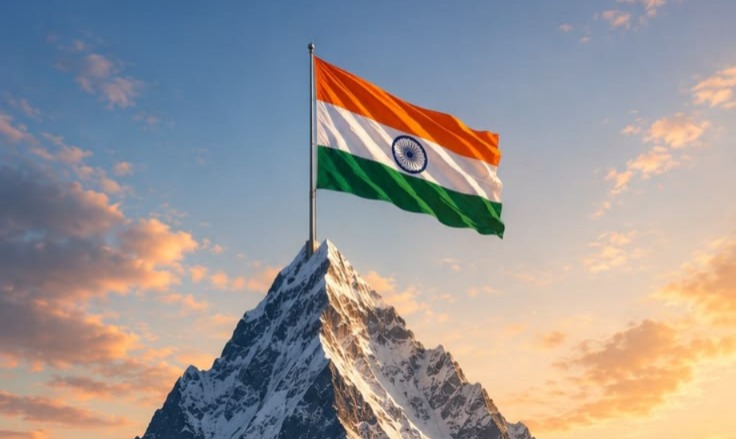
It is not just its flag.
It is us.
And that makes this conversation much harder.
Every Independence Day, we celebrate 1947 as though freedom arrived at our doorstep and stayed there forever.
But history was never quite that simple.
The British left India, yes. They gave us freedom from colonial rule, but their departure also came with Partition, hurried borders and questions that would outlive the Empire itself. Kashmir remains one of the most painful reminders of that unfinished history.
A place so breathtakingly beautiful, yet carrying a history marked by conflict, loss and uncertainty. When the British left, they did not leave behind a perfectly settled map. The question of Kashmir’s future became one of the many unresolved consequences of Partition, and generations after the British departure, the people of the region continue to live with the weight of that history.
In a strange way, it feels as though we became free from the British, only to inherit some of the unfinished questions their departure left behind.
They left.
The consequences did not.
And perhaps that is one of the uncomfortable truths about independence – freedom from a ruler does not automatically mean freedom from everything their rule left behind.
But look around.
Young people are still questioning whether their years of preparation will actually earn them a fair chance, especially after repeated controversies surrounding recruitment examinations and alleged paper leaks.
People are still asking whether they can disagree without being labelled disloyal.
Women still have to think about safety in places where they should simply be able to exist.
People still experience discrimination because of the name they carry, the religion they practise, the caste they were born into or the money they have in their pockets.
Workers still have to fight for dignity.
And minorities still sometimes have to explain why they belong to the very country they were born in.
So when we raise the tricolour, what exactly are we celebrating?
The freedom of a nation from foreign rule?
Yes.
That matters.
But independence was never supposed to be only about who governs us.
It was supposed to be about what that freedom would mean for the people living here.
Because what is the point of being independent as a nation if people within that nation still feel trapped by fear, prejudice, corruption, poverty or silence?
And this is where patriotism becomes complicated too.
I don’t think patriotism should require me to say that everything about India is beautiful.
I don’t think loving a country means defending every person who claims to represent it.
And I certainly don’t think criticising India means hating it.
Sometimes criticism is simply what remains when you care enough to want something to be better.
I can look at this country and acknowledge its progress while still being disturbed by its problems.
I can admire its diversity while being frustrated by how often that diversity becomes a reason to divide people.
I can respect the sacrifices of those who fought for independence while asking whether we have done justice to the freedom they imagined.
Because the India they fought for was not merely an India without the British.
It was an India where ordinary people could have a voice in their own future.
An India where freedom meant something beyond a flag.
And perhaps that is what we need to remember this year.
A flag cannot be free while the people beneath it are afraid.
A nation cannot call itself completely free when its citizens are still fighting to be treated equally.
And a democracy cannot remain healthy if questioning it is treated as betrayal.
Maybe I will never be the person who says, “I love India more than anything.”
But I do know this:
I don’t want to hate the place simply because of the people who have made it harder to love.
I want to be able to look at India and see something better than what we sometimes make of it.
I want a country where I don’t have to choose between being Muslim and being Indian.
Where being different does not make you less deserving of dignity.
Where a student can trust the system with their future.
Where a woman can exist without constantly calculating her safety.
Where a citizen can ask difficult questions without having their loyalty questioned.
Where patriotism is not measured by how loudly we praise the country, but by how sincerely we care about the people living in it.
Maybe that is the kind of independence we are still waiting for.
So yes, we celebrate 1947.
We remember the sacrifices.
We raise the flag.
We sing the poems.
But after all the celebrations are over, perhaps we should sit with one uncomfortable question:
We became independent from foreign rule decades ago.
But are we truly independent – when the very people living in this country can sometimes make us feel like we don’t belong in it?
3 Comments
I could deeply feel the words and I totally agree with every point.. Very well written, keep it up!
This is such a powerful and honest piece. It beautifully explains that loving your country doesn’t mean ignoring its problems, and questioning injustice doesn’t make someone less patriotic. The way it connects history, identity, faith, belonging, and the everyday struggles people still face is deeply meaningful. Some parts genuinely make you pause and think about what freedom and independence should really mean. 🤍🕊️
This is such a powerful and honest piece. It beautifully explains that loving your country doesn’t mean ignoring its problems, and questioning injustice doesn’t make someone less patriotic. The way it connects history, identity, faith, belonging, and the everyday struggles people still face is deeply meaningful. Some parts genuinely make you pause and think about what freedom and independence should really mean. 🤍🕊️