
Delhi Protests: Press Freedom, Police Excesses and the Crisis of Democracy

By Dr. M. Iqbal Siddiqui
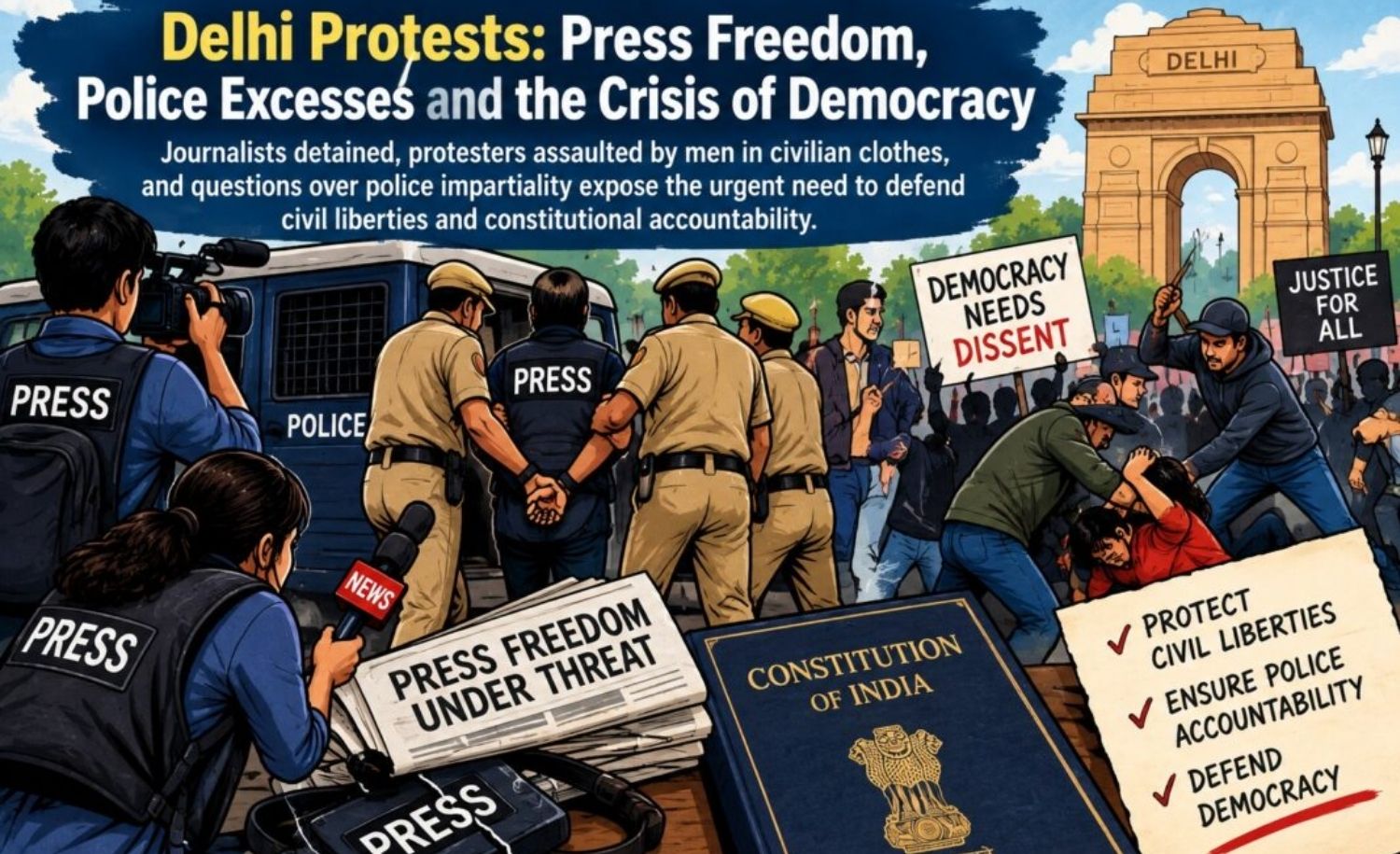
The events surrounding the protests in Delhi on 10 October 2026 have raised questions that go far beyond the handling of a demonstration. They concern the right to dissent, the freedom to report, the conduct of the police and the equal application of the law. When journalists are detained while documenting public events, protesters are assaulted in the presence of security personnel, and the conduct of those responsible for maintaining order remains unexplained, the issue is no longer merely one of crowd management. It is a test of constitutional democracy.
The protests, organised by the Cockroach Janta Party and supported by sections of civil society and opposition politics, demanded the resignation of Chief Election Commissioner Gyanesh Kumar amid allegations of irregularities in the revision of electoral rolls. The Election Commission and the government must answer allegations concerning the electoral process through transparent procedures. But whatever the merits of the protesters’ demands, their political position does not determine whether their fundamental rights deserve protection. The right to peaceful assembly and the freedom to scrutinise public institutions cannot depend on whether the government approves of those exercising them.
Journalists Detained for Doing Their Job
Reports from the ground describe journalists being detained while covering the protests, some despite identifying themselves as members of the press. Reuters reported that nearly three dozen journalists were detained, while journalists’ accounts published by Newslaundry and Alt News describe rough handling, unanswered questions about the legal basis of detention and difficulties in recovering equipment. Some reporters were transported far from the sites where they had been working.
These are not trivial inconveniences in the course of a difficult assignment. A journalist documenting a police operation performs a public function: recording what happened, questioning the authorities and preserving evidence that might otherwise remain unavailable to the public. Detaining reporters without a clearly communicated legal basis, obstructing their work or interfering with their equipment can deprive citizens of information essential to holding power accountable.
The danger is particularly acute when journalists become targets precisely because they are recording events that those exercising authority may prefer not to have scrutinised. The police cannot be the sole arbiters of which images, accounts or questions the public is permitted to see.
Men in Civilian Clothes, Violence in Public View
Even more disturbing are reports and video footage showing groups of men in civilian clothes assaulting protesters in central Delhi, including women and young people. Hindustan Times reported that men associated with right-wing organisations threatened journalists and assaulted protesters in Connaught Place and near the MCD Civic Centre. In one reported incident near Palika Bazaar, a group identifying itself as Bajrang Dal threatened journalists who were covering the demonstration. Four men accused of assaulting protesters were arrested and subsequently released on bail; reports identified them as linked to the Hindu Raksha Dal.
The issue is not resolved by those arrests. Nor does the grant of bail establish guilt or innocence. The central question remains: who were the men moving about in civilian clothes, what authority—if any—did they possess, and why were assaults reportedly taking place in the presence of uniformed police?
The footage and eyewitness accounts raise serious questions about police complicity or, at the very least, failure to intervene. These questions cannot be brushed aside with general assurances that law and order was being maintained. Where uniformed officers were visibly present alongside men assaulting protesters, the authorities must explain their conduct and why the violence was not stopped. If officers permitted, facilitated, or deliberately ignored unlawful violence, that conduct requires an investigation as serious as the assaults themselves.
A police force cannot claim exclusive authority to maintain public order while allowing unofficial groups to intimidate citizens in the same streets. No political or ideological affiliation should provide a licence to assault people, threaten journalists or perform the work of law enforcement without legal authority.
Allegations of Assault in Detention
The allegations extend beyond the streets. In accounts published by The Indian Express, detainees described being beaten, kicked and mistreated after being taken into police custody or to detention facilities. One detainee reported a fractured elbow; another, lawyer Fidal Tom, alleged that he was beaten after objecting to a man in civilian clothes assaulting detainees. Medical documentation was reported in connection with injuries suffered by detainees. According to the report, Delhi Police said it had received no formal complaints but would act if complaints were filed.
These allegations demand an independent and evidence-based investigation. Investigators must examine medical records, detention registers, CCTV footage, transport logs, and the identities of personnel on duty. The absence of a formal complaint cannot become a convenient reason to avoid scrutiny where credible accounts and medical evidence have been reported. Authorities must also ensure that detainees can complain safely, without fear of retaliation.
The allegations involving women journalists are particularly grave. Three women journalists reportedly accused Delhi Police personnel of sexual harassment during a protest at Jantar Mantar on 3 October. The National Human Rights Commission took suo motu cognisance and sought a detailed report from the Delhi Police Commissioner within two weeks. These remain allegations to be investigated, not findings of guilt.
On 15 October, the Supreme Court considered a proposal for a committee involving retired women judges and retired women police officers to examine allegations of sexual abuse against women journalists. It also directed that no coercive action be taken against a journalist facing a complaint from a police officer whom she had accused of sexual harassment. The proposed committee should not be described as formally constituted unless a subsequent order confirms that it has been established.
The sequence raises an essential question: can women journalists safely report on the exercise of state power if allegations of abuse are followed by counter-complaints that may expose them to further pressure? Every complaint must be assessed on its evidence. But counter-allegations must not be used to intimidate complainants or discourage scrutiny of official conduct.
The Supreme Court and the Rule of Law
The Supreme Court’s interventions underline the seriousness of the issues. On 15 October, it directed law-enforcement agencies to preserve CCTV footage and other digital material relating to the protests. It also directed Delhi Police to place on record prohibitory orders issued under Section 163 of the Bharatiya Nagarik Suraksha Sanhita during the preceding two weeks and issued notice on a challenge to the constitutional validity of Section 172, which concerns police powers to direct and remove people. The Court’s proceedings cover allegations of police excesses, detentions and restrictions on public movement.
Preserving evidence is crucial. Footage can establish who assaulted whom, which officers were present, whether intervention was attempted and how detainees were handled. Its preservation must be followed by a credible process of examination. Evidence that disappears, is withheld or is selectively disclosed can frustrate accountability before an investigation has properly begun.
The Court’s scrutiny does not itself establish that every allegation is true. It does, however, make clear that the issues merit serious judicial examination. The authorities must comply fully with the Court’s directions and explain the legal basis for restrictions and detentions. Public order is a legitimate responsibility of the State; it is not a blank cheque to suppress dissent or evade accountability.
The controversy over the Special Intensive Revision (SIR) of electoral rolls raises a related, though distinct, question of democratic accountability. The Supreme Court has issued notice to the Election Commission of India and its commissioners on a petition by Rahul Gandhi and 12 other INDIA bloc leaders alleging large-scale voter deletions and irregularities, seeking an independent audit, disclosure of records and safeguards against exclusion without notice. In a separate Delhi SIR matter, the Court advanced the hearing to 28 October on concerns about notices to electors and the use of Form 6 by voters whose names had been deleted. These procedural developments do not establish that the allegations are true; the Commission’s response and further judicial directions remain important. Yet they underline a fundamental constitutional principle: the authority to revise electoral rolls must be exercised transparently, fairly and with effective remedies against wrongful exclusion. While these proceedings are separate from the protest-related cases, both raise questions about the accountability of public institutions and the protection of citizens’ democratic rights.
Accountability Cannot Be Selective
Democracy demands answers, not assurances. Delhi Police must answer specific questions: Who were the men in civilian clothes allegedly beating protesters? Under whose authority were they operating? Why did uniformed officers appear to treat opposing groups differently? On what legal grounds were journalists detained? Were cameras, phones or other equipment seized, and have all such items and recordings been accounted for? What action has been taken on allegations of assault in detention and harassment of women journalists?
The Delhi Police Commissioner must ensure the preservation of all relevant CCTV footage, original video recordings, deployment registers, detention records and other evidence. Every credible allegation of assault, unlawful detention or intimidation must be investigated impartially—including the conduct of officers who witnessed violence or failed to intervene. Where wrongdoing is established, those responsible must face appropriate legal and departmental consequences, irrespective of rank, political connections or ideological affiliation. The Supreme Court and the National Human Rights Commission must pursue scrutiny within their respective mandates.
News organisations, journalists’ associations and civil-liberties groups must maintain a verified record of detentions, assaults, complaints and official responses. The public must not allow these incidents to disappear from view once the immediate confrontation has passed.
This is not a demand for impunity for protesters, nor an argument against legitimate police authority. It is a demand that the law apply equally to everyone. No political affiliation should confer protection from accountability; no dissenting opinion should invite punishment outside the law; and no journalist should have to calculate the personal cost of documenting the exercise of state power.
A democracy is not measured by the freedom enjoyed by those who agree with the government, but by the protection afforded to those who question it. When citizens are beaten, journalists are detained and the conduct of those exercising authority remains unexplained, the constitutional promise of liberty is placed at risk.
The question before Delhi—and before every institution charged with safeguarding the Constitution—is straightforward: will the rule of law be enforced impartially, or will accountability depend on who is protesting, who is reporting and who is wielding power?
The country deserves an answer. The victims deserve justice. And the Constitution demands that those responsible for upholding it be held to its standards.
this is Article published on India Tomorrow written by By Dr. M. Iqbal Siddiqui