
Challenges and Concerns of Indian Muslims in the Modi Era
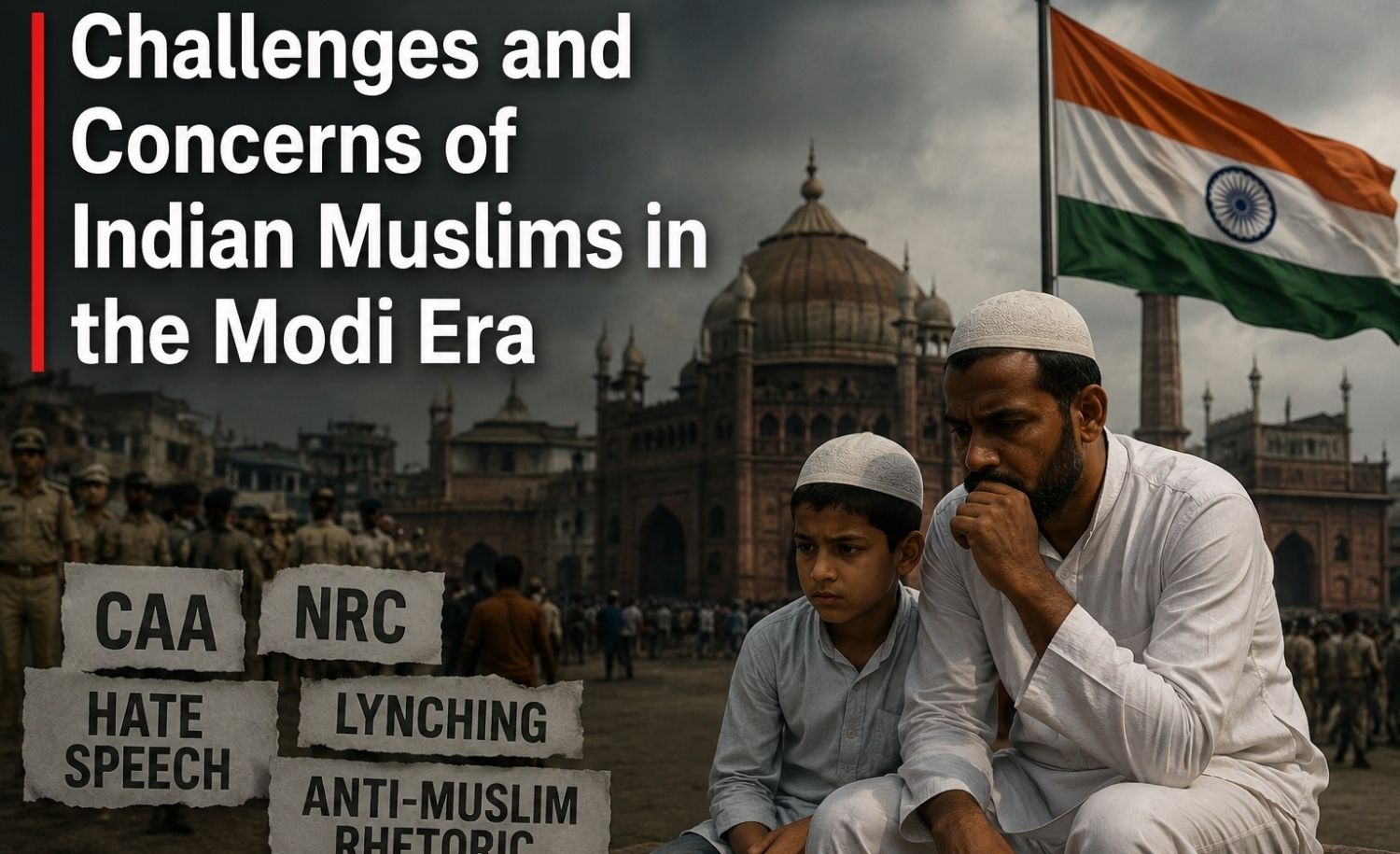

In the wake of a series of dangerous communal riots in the 1960s, Indian Muslims came together in Lucknow to establish the All India Muslim Majlis Mushawarat (AIMMM). The organisation sought to provide emotional and psychological support to the community and to encourage Muslims not to lose hope during a period of deep uncertainty. Today, many in the community believe that they are confronting even more serious challenges under the BJP-led central government since 2014. In response, Muslim leaders and organisations recently gathered in Delhi to deliberate on a collective strategy for the future. Their concern is that the present challenge is not merely political or administrative, but rooted in a broader ideological framework associated with the BJP and its government at the Centre.
By Syed Khalique Ahmed
Since 1947, Muslims in India have never faced challenges of the magnitude they are facing today. The only time they experienced extremely difficult circumstances was in the early and mid-sixties, when a series of large-scale anti-Muslim riots, particularly in Madhya Pradesh, Bihar and Orissa (now Odisha) shook the entire Muslim community. Hundreds of Muslims were killed and their houses and business properties were destroyed.
Muslims had never expected such a situation, given the promises of safety, security of life, and equality before the law that the Congress party and its government had made under India’s secular Constitution. However, the influence of secularism over the ruling establishment began to decline even during Nehru’s lifetime, enabling communal and anti-Muslim organisations such as the RSS and the Akhil Bharatiya Vidyarthi Parishad to create difficulties for Muslims who had chosen to remain in India as their nation. Muslims frequently bore the brunt of communal riots, owing to the indifference of Congress-led state governments. In the case of the Jabalpur riots in 1961, Prime Minister Pandit Jawaharlal Nehru himself acknowledged that Congress leaders remained confined to their homes and failed to take effective steps to stop the violence or protect Muslims from the rioters. The RSS and the Akhil Bharatiya Vidyarthi Parishad (ABVP) were alleged to be involved in the Jabalpur riots.
But these violent incidents targeting Muslims were not based on any particular ideology. Those were momentary developments ignited by certain immediate causes. The situation improved with the passage of time and the government took initiatives to do justice to the victims and punish the perpetrators of the crime. However, these measures were, most of the time, inadequate owing to RSS sympathisers and elements from the Hindu Mahasabha having infiltrated the ranks of the government. But the public posture of the government was that of a neutral and objective player. The government did not appear to be biased openly against Muslims. Wherever Muslims were strong in number, they confronted the rioters and challenged them.
These developments upset the Muslim political leaders, social workers, thinkers, religious leaders and businessmen. They found themselves highly confused and hopeless as to what to do as anti-Muslim riots – big and small – had become a routine affair. This forced Muslims of all shades and professions, transcending sectarian groups, to call a meeting at Lucknow in August 1964 under the leadership of Congress Rajya Sabha MP Syed Mahmud from Bihar, Maulana Abul Lais of Jamaat-e-Islami Hind and Maulana Syed Abul Hasan Ali Nadwi of Nadwatul Ulema of Lucknow to find a solution to the problem and offer emotional and psychological support to the Muslims. They urged the community to stay united and not to lose hope but to face the new situation with courage and conviction. This resulted in the birth of the All India Muslim Majlis Mushwarat, which played a significant role in making Muslims give up fear and face the difficulties with full bravery and determination. AIMMM, which is alive and working as a vibrant organisation to date, played a very positive role in those hard and challenging times. This was the response of the Muslim intellectuals and thinkers to the trying circumstances that had arisen before them at that time. They did not suggest taking aggressive measures like resorting to violence. Instead, they cooperated with the government in countering the anti-social elements with an agenda to harm the Muslim community in the newly Independent India.
Muslims face the most dangerous challenges since 2014
Now, Muslims in India face a more dangerous situation over the last 12 years after the BJP came to power at the Centre in May 2014 with former RSS pracharak and former Gujarat Chief Minister Narendra Modi as Prime Minister. While no major communal riots have taken place barring the Northeast Delhi riots in February-March 2020, a series of actions, including hate speeches by BJP leaders, state and union ministers, chief ministers of BJP-ruled states, and even anti-Muslim comments by the PM himself in public and election campaigns, have generated an anti-Muslim atmosphere all over the country.
State agencies bulldoze madrasas, mosques, overlook mob lynching of Muslims
Central and state BJP governments are targeting mosques, mausoleums, madrasas (religious seminaries), and Muslim educational institutions. Even their residential and commercial centres are being bulldozed on the pretext of having been built illegally and without permission of the concerned government departments.
Though no exact figures are available about the number of mosques having been demolished by authorities in Delhi, UP, MP, Rajasthan, Gujarat and other states, estimates suggest their numbers are in hundreds. They were bulldozed simply because the government claimed that they were encroachments on government land or constructed without permission from urban or district authorities. However, similarly placed religious buildings of Hindus, existing just adjacent to the Muslims religious places, remain untouched. A large number of madrasas in Uttarakhand, UP, Assam and other states have either been sealed or demolished. Court cases have been initiated to take over the historic Gyanvapi Mosque in Varanasi and Shahi Eidgah Mosque in Mathura, as was done in the case of Babri Masjid in Ayodhya. This is being done in violation of the Places of Worship Act, 1991, that categorically says that the nature and character of a religious place as it existed on August 15, 1947, will not be altered. But, recently, a court in Madhya Pradesh permitted Hindus to pray in Kamal Maula Mosque while preventing entry of Muslims in it.
A nationwide campaign was launched by radical Hindu groups against the wearing of scarves and burqas (hijabs) by Muslim women in schools and colleges. A member of the Rajya Sabha (Upper House of Parliament), Nitish Kumar, while serving as Chief Minister of Bihar, pulled the scarf of a Muslim doctor during a public interaction, indicating deep hatred against Muslim culture even among those holding Constitutional posts.
A large number of mosques in border areas of Gujarat and Rajasthan were bulldozed on the ground that they posed a security threat. Earlier, dozens of mosques in several districts of UP bordering Nepal were also demolished on the allegations of them being national security threat.
In Assam, dozens of mosques and madrasas were bulldozed on the allegations that they were on government land. More than five lakh Muslims are reported to have been displaced internally by the Assam government by bulldozing their houses, on the pretext that they were built on forest or government land.
A new type of violence emerged post-2014 in India called mob lynching, in which Muslims travelling alone or in groups of two or three were targeted. The modus operandi was to accuse them of being beef sellers, cow smugglers or thieves. Vigilantes from radical Hindu organisations would attack and kill them. In most cases, police would book cases against Muslim victims, allowing Hindu accused persons to go scot-free. This generated awe and fear among Muslims. At least 45 people were reported to have been killed in mob-lynching cases between 2014 and early 2018, but researchers believe the cumulative number of mob-lynching and related vigilante killings since 2014 is significantly higher; an exact nationwide total is not available from the National Crime Records Bureau (NCRB) statistics because the police in states stopped booking mob lynching cases as such after 2018. The 2019 Citizenship(Amendment)Act, which has now become a law, is also viewed as legislation to harass and victimise Muslims.
Muslim institutions under threat from state apparatuses
The BJP state governments have also selectively acted against Muslim-run higher educational institutions. While the Haryana government has jailed the founder of the Al-Falah University in Ballabhgarh and appointed a government administrator to run the university, the UP government has issued notices to demolish 38 out of 40 buildings of Mohammed Ali Jauhar University in Rampur. Dr. Mahbubul Hoque, Chancellor of University of Science and Technology Meghalaya(USTM), was arrested by the Assam Police and jailed in connection with an alleged examination-malpractice case, though his supporters described the action as politically motivated. The UP and central agencies have initiated cases against former MLC Mohammed Iqbal and his family, who control the affairs of the Abdul Waheed Educational and Charitable Trust. The trust runs Glocal University at Saharanpur. The university has been accused of money laundering and issuing fake certificates. Jamia Islamia Ishaatul Uloom(JIIU), an educational institute at Akkalkuwa in Maharashtra, has been accused of foreign funding irregularities, illegal shelter of foreign nationals, andtribal land encroachment, creating problems for this institution with more than 15,000 on its rolls. Many other Muslim-run higher educational institutions also face cases of varied nature. This raises an important question: Are Muslim-run higher educational institutions the only ones accused of violating regulatory norms? According to various media reports, numerous privately managed universities and colleges operated by non-Muslim groups have also been found involved in violations, in some cases of a much more serious nature. Nevertheless, such institutions do not seem to attract the same level of scrutiny, punitive action, or governmental hostility from the concerned state authorities.
Curtailment of Muslims’ democratic, political and religious rights
In addition, Muslims are increasingly raising concerns that their democratic and political rights are being curtailed under the Narendra Modi government. The Special Intensive Revision (SIR) of electoral rolls in Bihar, Uttar Pradesh, and several other states has disproportionately impacted Muslims, leading to concerns about the disenfranchisement of a large number of voters. Muslim representation in state assemblies and Parliament is continuously diminishing. The Narendra Modi government is the first to have no Muslim representation in its cabinet. Any attempt by Muslims to raise their voice against injustices against them through demonstrations and rallies is dealt with strongly by the police. Making the singing of Vande Mataram compulsory, and introducing a law that criminalises refusal to sing it or failure to show respect for it, would constitute a direct infringement of the freedom of religion guaranteed to Muslims under Article 25 of the Indian Constitution. Muslims, who believe in the worship of One and Only One God called Allah in the Quran, say Vande Mataram is based on polytheism and hence clashes with the monotheistic religion of Islam. The BJP government appears to be gradually curtailing the constitutional rights of Muslims and, through the legislative process, attempting to compel them to compromise with their religious beliefs and practices. Muslims consider the compulsory singing of Vande Mataram to be a grave challenge to their religious identity and constitutionally protected freedom of conscience as a religious community in India.
Muslims relegated as second-class citizens in New India
Viewed in totality, these developments indicate a growing perception that Muslims in the BJP’s “New India” are being relegated to the status of second-class citizens—treated more as subjects of state authority than as citizens possessing equal rights under the Constitution. This aligns with the theory propounded by Hindutva ideologue V D Savarkar, in which Muslims and Christians having their “punyabhoomi” (religious places) outside the geographical boundaries of India will not be treated as equal citizens but to a secondary position having no political rights. In general parlance, they are to be treated as second-class citizens, with no political rights and no constitutional protection. The central BJP government seems to be working to achieve this particular objective, particularly concerning Muslims. These developments are dangerous because they appear to be occurring as part of a broader ideological agenda directed against Muslims, rather than as a response to temporary events or immediate circumstances.
Delhi Consultation on Emerging Challenges
Taken together, these developments, unfolding over more than twelve years of BJP rule under Prime Minister Narendra Modi, have created a growing sense of insecurity and concern among Indian Muslims regarding their constitutional rights, religious freedom, and equal status as citizens of the Republic.
Consequently, prominent Indian Muslims, including Parliamentarians, former chief minister, former ministers, jurists, scholars, legal practitioners, retired bureaucrats, professionals and civil society leaders from Kashmir to Kerala and from Assam to Gujarat and Maharashtra, met at the Constitution Club of India in New Delhi on July 24, 2026, under the banner of Indian Muslims for Civil Rights (IMCR) to deliberate upon the issues confronting the Muslim community and erosion of its constitutional rights. Prominent among those present in the “National Consultative Meeting of Muslim Leaders and Intellectuals” included its convener Mohammed Adeeb, former J&K chief ministers Dr Farooq Abdullah and Mehbooba Mufti, former union minister Salman Khurshid, President of Jamaat-e-Islami Hind Syed Sadatullah Husaini, Shia leader Kalb-e-Jawad and Indian Union Muslim League (IUML) MP from Kerala E T Basheer. The meeting passed as many as eight resolutions, describing them as “New Delhi Declaration on Assertion of Rights of Muslims in India”. The consultative committee formed a 51-member committee to further discuss the issue and submit their grievances and demands to President of India Droupadi Murmu and Chief Justice of India Surya Kant.
Don’t follow Israeli Model
Muslim intellectuals feel that whatever the BJP central government is doing about the Constitutional rights of Muslims will affect India’s relations with Muslim countries. Muslim intellectuals feel that the government of India should not follow the Israeli model to design policies about its Muslim citizens but evolve its own policy based on the provisions of the Indian Constitution. Indian Muslims have inclusive thoughts; they have demonstrated their ability to co-exist in a multi-cultural society; they have never been aggressive; they have never supported violence and they have always believed in the Constitution and Constitutional values. They have also believed in inclusive discussion to solve problems.
Is “Viksit Bharat” possible while excluding Muslims?
Having said this, a question arises: Do the actions taken about Muslims in the last over 12 years against Muslims truly contribute to the realisation of Prime Minister Modi’s vision of a “Viksit Bharat” (Developed India)? How can a nation achieve such a goal when nearly 15 percent of its population feels deprived of political rights and is made to feel like second-class citizens? The answer to these questions will certainly be “not” by any right-thinking person.
The Government of India must listen to the grievances of Muslims and take corrective measures to ensure that India’s Muslim population is not deprived of its political and economic rights and is given a chance to use its full potential in nation building. The government of India should not consider the Muslim convention negatively and as a threat to the government.
Muslim youths have a lot of potential. They are not after government jobs. They are less aspirational for government jobs. They are also not part of protests over unemployment. A government report says that Muslims are mostly in self-employment. If this talent of the Muslims is properly channelised by the government, the Muslim youths can contribute a lot in generating employment in the private sector.
Inclusive politics needed for “Viksit Bharat” and nation building
An important suggestion is that the dream of “Viksit Bharat” cannot be achieved merely through economic development. The nation requires simultaneous political development as well. The government and the party in power need to practice inclusive politics in which all communities – irrespective of their faith, language, or region – have the opportunity to realise their dreams based on Constitutional principles of equality, fraternity and justice. The vision of “Viksit Bharat” cannot be achieved by practicing exclusivist politics that favours one particular group and tends to exclude, marginalise, or deny equal participation to others. What is urgently required is a political course correction towards a genuinely inclusive politics in which every community has an equal opportunity to realise its full potential and contribute effectively to the collective project of nation-building.
*The author is the Chief Editor of India Tomorrow news portal. and uploaded by them