
A Lamp Wrapped in Smoke, Burning in the Fire of Addiction — Mujeeb!

Mufti Ashfaq Qazi
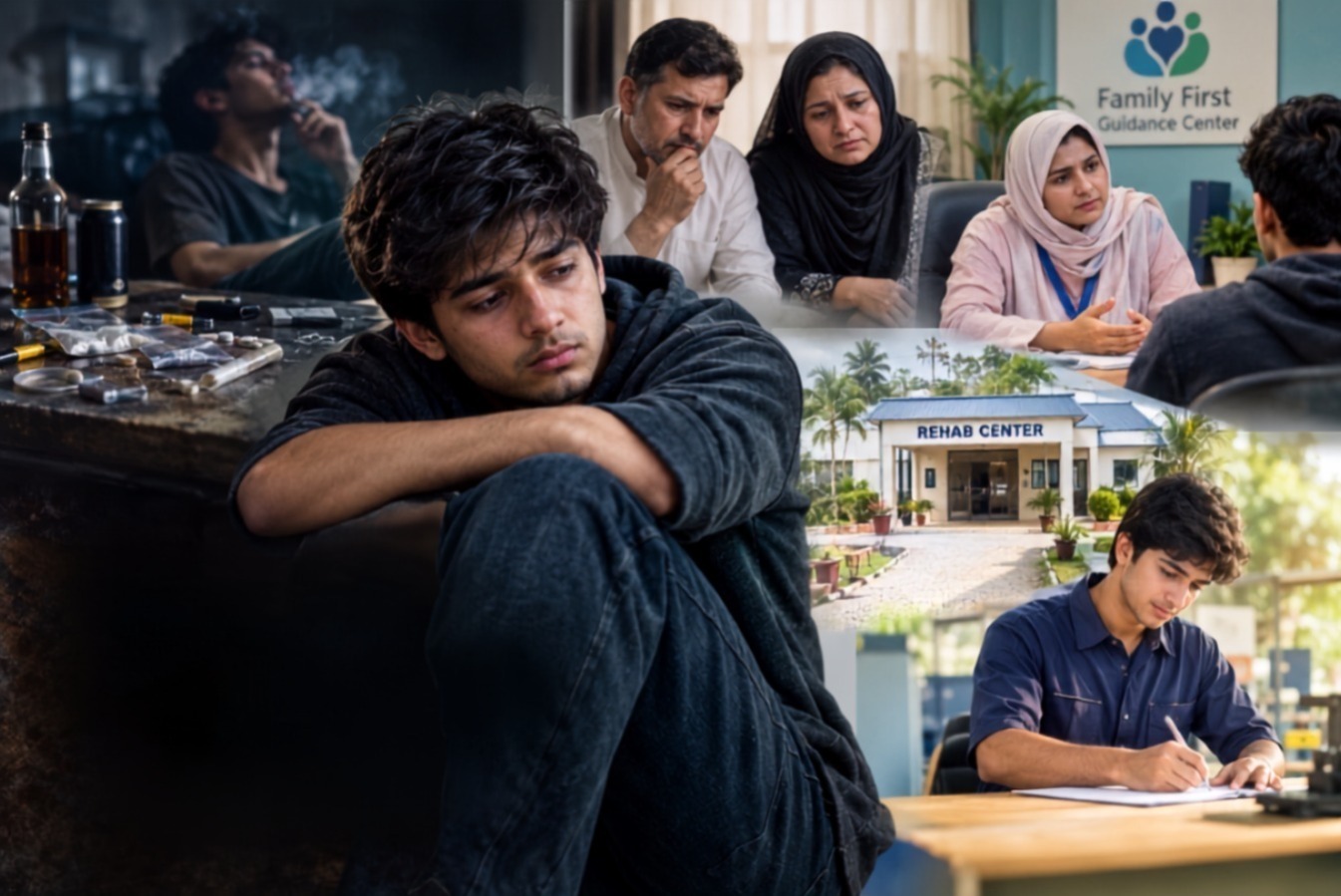
When Mujeeb (a pseudonym) arrived at Family First Guidance Centre with his parents, his parents had a long list of complaints, but Mujeeb had very little to say. He sat quietly in front of us. His eyes would sometimes remain fixed on the floor, then suddenly rise and rest on someone’s face, only to drop again.
His face suggested that he had spent many nights awake. His body showed that he was no longer in control of himself, and his eyes seemed constantly to be searching for something without which he could not find peace.
Our counsellor, Gulnaz Madam, who handled Mujeeb’s case, did not immediately begin questioning him. Perhaps because with young people like him, you first have to listen to them. Before entering into their lives, you have to make them believe that the person sitting across from them is not talking to them as if they were a criminal.
After several meetings, Mujeeb finally opened the door to what was inside him. He told us about the different kinds of drugs he had become involved with, where he obtained them, how he used them, and how one substance gradually led him to another.
As he spoke, he did not seem like someone who wanted to end his life. There were still desires within him, plans, and the motivation to do something with his life. He was an intelligent boy with creative abilities. He wanted to start his own business. Rather than work under someone else, he dreamed of standing on his own feet.
His parents were not financially weak either. They belonged to a reasonably well-off family. They thought that if they gave their son his own business, it would keep him occupied, give him responsibility, and perhaps help him regain control of his life.
They handed over an ongoing project to him.
But along with the business came something else—loneliness.
He had to live away from home. There was no mother watching over him, no father asking where he was, no one expecting him to be somewhere at a particular time. He had money in his pocket and the freedom to make his own decisions.
For some time, everything seemed fine.
Then, gradually, Mujeeb began losing interest in his work. His anger increased. He became irritated over small things. He started hiding things from his family and avoiding direct answers.
Before his parents could understand what was happening, Mujeeb would come up with another explanation—sometimes the pressure of business, sometimes a friend’s problem, sometimes an excuse that he was not feeling well.
The family perhaps also wanted their suspicions to be wrong. It is not easy for parents to think badly of their own child. Until the very last moment, parents keep finding reasons to defend their children.
But after seeing what was actually happening, our counsellor clearly told the family that the matter could no longer be handled simply by keeping Mujeeb at home and trying to reason with him. He needed to be admitted to a rehabilitation centre immediately.
For his parents, this was not an easy decision either.
The son they had watched grow up before their eyes, the son for whose better future they had spent their entire lives saving—leaving that same son at a rehabilitation centre, where he would have to stay away from home for some time in a structured environment, was not a simple decision for any mother.
But sometimes the love of a family is not enough to save a child. Sometimes, along with that love, a difficult and painful decision has to be made.
Mujeeb’s case is not limited to the four walls of one home.
From the Muslim areas of Mumbai such as Madanpura, Kurla, Govandi and Wadala to Thane, Mumbra, Bhiwandi, Malegaon, Azamgarh, Delhi, Patna and Hyderabad, the network of drug addiction has spread so widely that young people are becoming familiar not only with the names of these substances but also with the ways and means of obtaining and using them.
Hashish, cannabis, heroin, brown sugar, MD, ice—these and similar drugs are now reaching the hands of children whose hands once held pens.
It often begins so quietly that nobody notices.
A gathering of friends. A little curiosity. An attempt to escape from some emotional difficulty.
Then that one time becomes a second time.
And eventually, the young person is no longer making the decision himself. His body and mind begin making the decision for him.
After that, the entire household begins to change.
More money is demanded. Things are hidden. Coming home late at night becomes routine. Anger and lies become common.
A mother finds something in her son’s room and holds it in her hand for a long time, unable to believe that it belongs to the same child whom she once held in her arms.
When money disappears from the father’s pocket, he first suspects someone else—not his own son.
And when the truth finally comes out, a silence settles over the home that is more frightening and dangerous than noise.
We still tend to think of addiction as someone else’s child’s problem, while assuming that our own homes are safe.
But addiction does not knock on the door based on someone’s name, status or religious identity.
A child who finds no one at home with whom he can talk, whose loneliness no one understands, and who finds acceptance somewhere else can slowly become drawn towards that world.
In any case, Mujeeb was sent to a rehabilitation centre.
Initially, the process was not easy for him. Staying away from something without which his body and mind could not find peace is not simply a matter of giving up a habit.
For his family too, every day brought the same question:
Would their son return? And if he did, would he be the same person he had once been?
But treatment, supervision and continuous counselling gradually achieved what scolding, tears and repeated explanations at home had failed to achieve.
Today, Alhamdulillah, more than two years have passed.
Mujeeb has stayed away from drugs. He lives with his parents, works, and leads a normal life.
The same boy whose parents once lived in fear of what condition he would return home in is now someone they see busy with his work.
When we meet him today, there is no longer the anxiety in his conversation that was evident in the beginning. He talks about his future. He thinks about his work. And he no longer avoids eye contact with people before whom it was once difficult for him even to sit.
This one young man’s case made one thing very clear:
It is easy to consider every young person trapped in addiction as finished, as if there is no life left in him.
What is difficult is to give him time and help him return.
Parents often seek help only after years of conflict have taken place at home, money has been wasted, relationships have been damaged and the child himself has become disappointed with his own life.
Why do they not come earlier?
Perhaps because they feel ashamed.
Perhaps because they fear what people in the neighbourhood will say.
Perhaps because they keep hoping that the child will somehow recover at home.
But addiction does not disappear because of shame.
It does not disappear by hiding it.
It does not disappear through scolding.
And every time we give money, cover up mistakes, or protect the child from the police or relatives, the problem may become even more serious.
A child must certainly be made to feel that the family is not against him—but the family is not with his addiction either.
Most importantly, we should not only want to see our children successful. We should also want to see them safe and healthy.
Mujeeb’s parents did not recognise the problem in time. But once the truth became clear, they did not close their eyes to it.
Perhaps that difference stood between saving his life and losing it.
Today, in countless homes, there may be another Mujeeb sitting silently.
His mother may simply consider him rude.
His father may consider him useless.
His sister may be afraid of him.
And he himself may be waiting for someone to extend a hand and pull him out of a place he reached on his own feet but from which he can no longer return alone.
Perhaps in some home, a mother is already noticing a change in her son’s eyes but is ignoring it as merely a part of growing up.
Perhaps a father is finding less money in his wallet and dismissing it as a small act of mischief by his son.
Perhaps a young man’s friends have changed, his nights outside the home have increased, and his family is satisfied by simply calling him irresponsible or wayward.
Not every change is a sign of drug use.
But some changes are certainly serious enough that ignoring them can prove extremely costly.
What we need is to maintain a relationship within the family where a son can speak about his mistakes instead of hiding them; where a father is not merely someone who interrogates him, and a mother is not merely someone who scolds him.
The longer drug addiction continues, the more difficult the road back becomes.
That is why paying attention to the first signs, seeking professional advice at the right time, and, when necessary, arranging treatment at a rehabilitation centre can prevent many families from reaching a point where nothing remains except tears.
Mujeeb is now with his parents. He is working and rebuilding his life.
But another family’s son could be in his place.
The only difference may be that nobody has yet understood his silence, noticed the exhaustion in his eyes, or knocked on the closed door of his room.
Sometimes, one question, one act of attention, one serious conversation and one timely decision can bring a young person back from a path that has begun to look impossible to return from.
Mujeeb came back. But how many other Mujeebs are still walking down the same road, waiting to be stopped, understood and brought back in time?
These young people are not merely the children of their parents; they are the future of our nation.
Their hands should not be holding drugs. They should be holding knowledge, skills and responsibility.
Their eyes should not carry the sleeplessness of addiction. They should carry dreams of a better tomorrow.
When a young person falls into addiction, it is not merely the loss of one individual. It is a loss for society and for the nation.
If Mujeeb’s life could be rebuilt, then the doors are not closed for other young people either.
The only condition is that we must not abandon them after they fall, and when they try to return, we must not close the door of the home in their face.
Instead, we must keep that door open.
The writer is a renowned Islamic scholar, religious scholar, teacher of Hujjaj, Shariah Advisor, author, columnist, Sadr Mufti of Darul Ifta wal Irshad, Juma Masjid Bombay, and Founder & Director of Family First Guidance Centre
When Mujeeb (a pseudonym) arrived at Family First Guidance Centre with his parents, his parents had a long list of complaints, but Mujeeb had very little to say. He sat quietly in front of us. His eyes would sometimes remain fixed on the floor, then suddenly rise and rest on someone’s face, only to drop again.
His face suggested that he had spent many nights awake. His body showed that he was no longer in control of himself, and his eyes seemed constantly to be searching for something without which he could not find peace.
Our counsellor, Gulnaz Madam, who handled Mujeeb’s case, did not immediately begin questioning him. Perhaps because with young people like him, you first have to listen to them. Before entering into their lives, you have to make them believe that the person sitting across from them is not talking to them as if they were a criminal.
After several meetings, Mujeeb finally opened the door to what was inside him. He told us about the different kinds of drugs he had become involved with, where he obtained them, how he used them, and how one substance gradually led him to another.
As he spoke, he did not seem like someone who wanted to end his life. There were still desires within him, plans, and the motivation to do something with his life. He was an intelligent boy with creative abilities. He wanted to start his own business. Rather than work under someone else, he dreamed of standing on his own feet.
His parents were not financially weak either. They belonged to a reasonably well-off family. They thought that if they gave their son his own business, it would keep him occupied, give him responsibility, and perhaps help him regain control of his life.
They handed over an ongoing project to him.
But along with the business came something else—loneliness.
He had to live away from home. There was no mother watching over him, no father asking where he was, no one expecting him to be somewhere at a particular time. He had money in his pocket and the freedom to make his own decisions.
For some time, everything seemed fine.
Then, gradually, Mujeeb began losing interest in his work. His anger increased. He became irritated over small things. He started hiding things from his family and avoiding direct answers.
Before his parents could understand what was happening, Mujeeb would come up with another explanation—sometimes the pressure of business, sometimes a friend’s problem, sometimes an excuse that he was not feeling well.
The family perhaps also wanted their suspicions to be wrong. It is not easy for parents to think badly of their own child. Until the very last moment, parents keep finding reasons to defend their children.
But after seeing what was actually happening, our counsellor clearly told the family that the matter could no longer be handled simply by keeping Mujeeb at home and trying to reason with him. He needed to be admitted to a rehabilitation centre immediately.
For his parents, this was not an easy decision either.
The son they had watched grow up before their eyes, the son for whose better future they had spent their entire lives saving—leaving that same son at a rehabilitation centre, where he would have to stay away from home for some time in a structured environment, was not a simple decision for any mother.
But sometimes the love of a family is not enough to save a child. Sometimes, along with that love, a difficult and painful decision has to be made.
Mujeeb’s case is not limited to the four walls of one home.
From the Muslim areas of Mumbai such as Madanpura, Kurla, Govandi and Wadala to Thane, Mumbra, Bhiwandi, Malegaon, Azamgarh, Delhi, Patna and Hyderabad, the network of drug addiction has spread so widely that young people are becoming familiar not only with the names of these substances but also with the ways and means of obtaining and using them.
Hashish, cannabis, heroin, brown sugar, MD, ice—these and similar drugs are now reaching the hands of children whose hands once held pens.
It often begins so quietly that nobody notices.
A gathering of friends. A little curiosity. An attempt to escape from some emotional difficulty.
Then that one time becomes a second time.
And eventually, the young person is no longer making the decision himself. His body and mind begin making the decision for him.
After that, the entire household begins to change.
More money is demanded. Things are hidden. Coming home late at night becomes routine. Anger and lies become common.
A mother finds something in her son’s room and holds it in her hand for a long time, unable to believe that it belongs to the same child whom she once held in her arms.
When money disappears from the father’s pocket, he first suspects someone else—not his own son.
And when the truth finally comes out, a silence settles over the home that is more frightening and dangerous than noise.
We still tend to think of addiction as someone else’s child’s problem, while assuming that our own homes are safe.
But addiction does not knock on the door based on someone’s name, status or religious identity.
A child who finds no one at home with whom he can talk, whose loneliness no one understands, and who finds acceptance somewhere else can slowly become drawn towards that world.
In any case, Mujeeb was sent to a rehabilitation centre.
Initially, the process was not easy for him. Staying away from something without which his body and mind could not find peace is not simply a matter of giving up a habit.
For his family too, every day brought the same question:
Would their son return? And if he did, would he be the same person he had once been?
But treatment, supervision and continuous counselling gradually achieved what scolding, tears and repeated explanations at home had failed to achieve.
Today, Alhamdulillah, more than two years have passed.
Mujeeb has stayed away from drugs. He lives with his parents, works, and leads a normal life.
The same boy whose parents once lived in fear of what condition he would return home in is now someone they see busy with his work.
When we meet him today, there is no longer the anxiety in his conversation that was evident in the beginning. He talks about his future. He thinks about his work. And he no longer avoids eye contact with people before whom it was once difficult for him even to sit.
This one young man’s case made one thing very clear:
It is easy to consider every young person trapped in addiction as finished, as if there is no life left in him.
What is difficult is to give him time and help him return.
Parents often seek help only after years of conflict have taken place at home, money has been wasted, relationships have been damaged and the child himself has become disappointed with his own life.
Why do they not come earlier?
Perhaps because they feel ashamed.
Perhaps because they fear what people in the neighbourhood will say.
Perhaps because they keep hoping that the child will somehow recover at home.
But addiction does not disappear because of shame.
It does not disappear by hiding it.
It does not disappear through scolding.
And every time we give money, cover up mistakes, or protect the child from the police or relatives, the problem may become even more serious.
A child must certainly be made to feel that the family is not against him—but the family is not with his addiction either.
Most importantly, we should not only want to see our children successful. We should also want to see them safe and healthy.
Mujeeb’s parents did not recognise the problem in time. But once the truth became clear, they did not close their eyes to it.
Perhaps that difference stood between saving his life and losing it.
Today, in countless homes, there may be another Mujeeb sitting silently.
His mother may simply consider him rude.
His father may consider him useless.
His sister may be afraid of him.
And he himself may be waiting for someone to extend a hand and pull him out of a place he reached on his own feet but from which he can no longer return alone.
Perhaps in some home, a mother is already noticing a change in her son’s eyes but is ignoring it as merely a part of growing up.
Perhaps a father is finding less money in his wallet and dismissing it as a small act of mischief by his son.
Perhaps a young man’s friends have changed, his nights outside the home have increased, and his family is satisfied by simply calling him irresponsible or wayward.
Not every change is a sign of drug use.
But some changes are certainly serious enough that ignoring them can prove extremely costly.
What we need is to maintain a relationship within the family where a son can speak about his mistakes instead of hiding them; where a father is not merely someone who interrogates him, and a mother is not merely someone who scolds him.
The longer drug addiction continues, the more difficult the road back becomes.
That is why paying attention to the first signs, seeking professional advice at the right time, and, when necessary, arranging treatment at a rehabilitation centre can prevent many families from reaching a point where nothing remains except tears.
Mujeeb is now with his parents. He is working and rebuilding his life.
But another family’s son could be in his place.
The only difference may be that nobody has yet understood his silence, noticed the exhaustion in his eyes, or knocked on the closed door of his room.
Sometimes, one question, one act of attention, one serious conversation and one timely decision can bring a young person back from a path that has begun to look impossible to return from.
Mujeeb came back. But how many other Mujeebs are still walking down the same road, waiting to be stopped, understood and brought back in time?
These young people are not merely the children of their parents; they are the future of our nation.
Their hands should not be holding drugs. They should be holding knowledge, skills and responsibility.
Their eyes should not carry the sleeplessness of addiction. They should carry dreams of a better tomorrow.
When a young person falls into addiction, it is not merely the loss of one individual. It is a loss for society and for the nation.
If Mujeeb’s life could be rebuilt, then the doors are not closed for other young people either.
The only condition is that we must not abandon them after they fall, and when they try to return, we must not close the door of the home in their face.
Instead, we must keep that door open.
The writer is a renowned Islamic scholar, religious scholar, teacher of Hujjaj, Shariah Advisor, author, columnist, Sadr Mufti of Darul Ifta wal Irshad, Juma Masjid Bombay, and Founder & Director of Family First Guidance Centre
The short URL of the present article is: https://english.fikrokhabar.com/aiju