Thousands Stage ‘Jail Bharo’ Protest in Jalgaon Against Waqf Amendment Act
Muslim groups and civil society allies demand repeal of controversial law they say threatens constitutional rights and community autonomy.
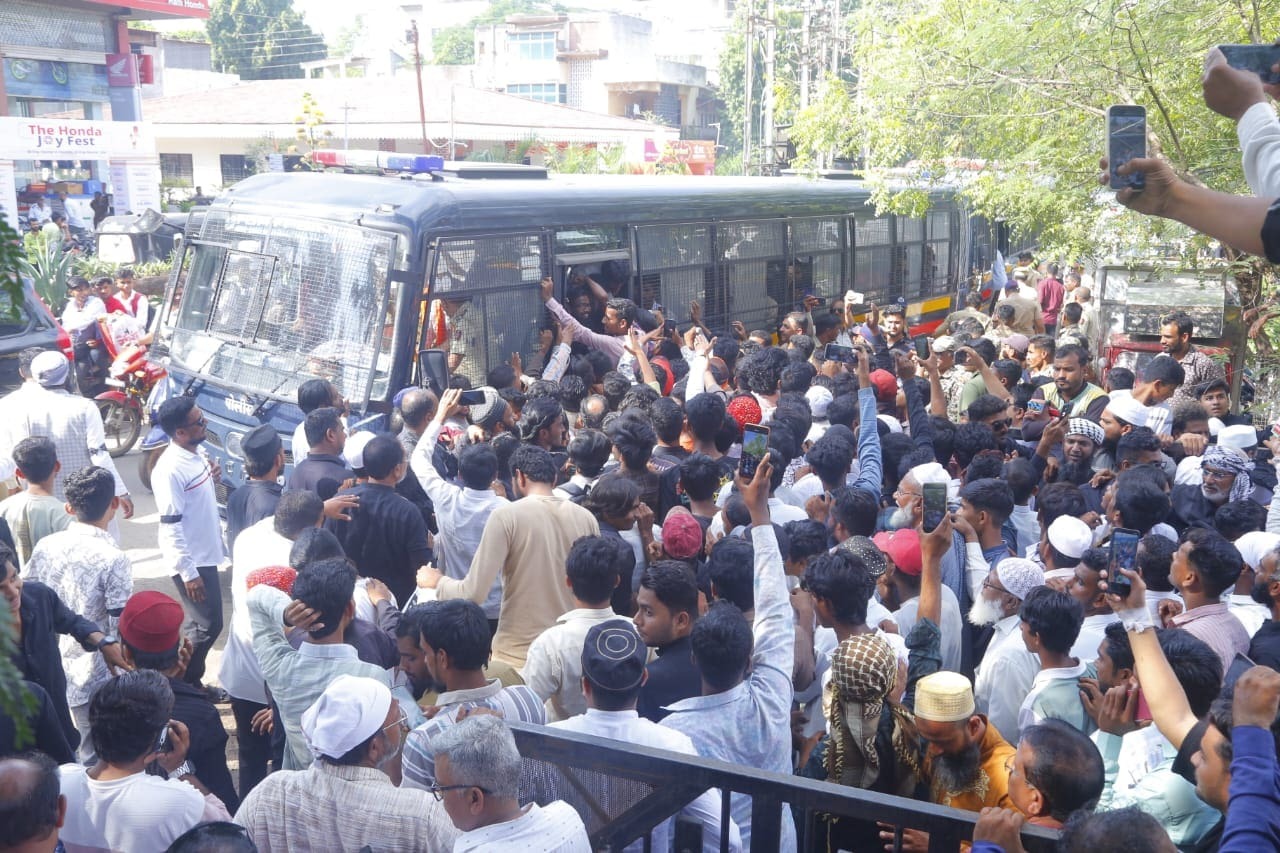

Thousands of demonstrators gathered in Jalgaon, Maharashtra, on Monday to protest against the newly enacted Waqf (Amendment) Act, 2025. The massive turnout reflected growing anger among Muslim communities nationwide, who have labeled the legislation a “black law” that undermines their religious and constitutional freedoms.
The protest, organized by the Tahaffuz Awqaf Committee Jalgaon (also known as Waqf Bachao Samiti), took the form of a “Jail Bharo Andolan” a voluntary mass arrest campaign. The event followed a protest blueprint laid out by the All India Muslim Personal Law Board (AIMPLB), which had planned a similar demonstration at Delhi’s Jantar Mantar on October 12 but was denied permission by police.
Jalgaon became the first district in the country to successfully carry out a full-scale Jail Bharo protest under this campaign.
Peaceful Protest Ends With Mass Detentions
The demonstration began with a two-hour sit-in at G.S. Ground. Police detained approximately 2,000 participants, who were taken to Jilha Peth Police Station and released later that evening.
Organizer Farooq Shaikh described the protest as a united stand for justice. “We voluntarily submitted ourselves to the police as part of the Jail Bharo Morcha,” he said. “Over two thousand people joined not just Muslims, but people from all communities and political backgrounds who believe in justice, equality, and the Constitution.”
Shaikh emphasized that the movement is nationwide in scope and that Jalgaon had set an example with its peaceful execution. “Our message to the government is clear we will not accept this unconstitutional law under any circumstances,” he added.
Five Key Demands Submitted to Authorities
A delegation led by Mufti Khalid, president of the Tahaffuz Awqaf Committee, met with Additional Collector Shrimant Harkar to submit a formal memorandum addressed to the President of India. The document outlined five major demands:
- Immediate repeal of the Waqf (Amendment) Act, 2025
- An end to central government control over Waqf properties
- Establishment of independent and transparent Waqf Boards managed by the community
- Strict action against encroachments and illegal transfers of Waqf land, including by influential community members
- Extension of the December 5 deadline for e-registration of mosques, madrasas, and dargahs on the UMEED Portal
Speaking to Maktoob, Mufti Khalid said the law interferes with both religious practice and the right to self-governance. “Our ancestors chose to stay in India after Partition because they believed in justice and equality this movement is to protect that promise: faith, the Constitution, and justice together,” he stated.
He argued that the amendment violates Articles 25 to 30 of the Constitution, which guarantee religious freedoms and the rights of minorities to manage their own institutions.
Political and Social Groups Lend Support
The protest drew backing from multiple political and social organizations, including the Bahujan Kranti Morcha, the NCP (Ajit Pawar faction), and the Vanchit Bahujan Aghadi (VBA).
VBA district president Shameebha Bhanudas Patil endorsed the five demands and criticized the amendment as a product of “Manuwadi and Sanghadi ideology” designed to curtail the social and economic independence of Muslims.
Pratibha Shinde of the NCP called the law “anti-constitutional” and said it undermines India’s secular foundation. “When Partition tore the subcontinent apart, only one community was asked to choose and Muslims chose this land, their homeland,” Shinde said. “They are Indians by choice, not by chance. This law insults that choice, and we stand firmly with the Muslim community in defending their constitutional rights.”
Why Waqf Properties Matter
Protesters highlighted the essential role Waqf properties play in community welfare. These properties fund not only mosques and madrasas but also schools, hospitals, and colleges that serve poor and marginalized populations, particularly in North Maharashtra, Nandurbar, and Jalgaon.
“When control tightens on Waqf lands, it isn’t only property that’s taken it’s the lifeline that funds education for our children,” one organizer explained.
Warning of Further Action
Farooq Shaikh made it clear that the Jalgaon protest is just the beginning. “If this law is not repealed, we will escalate road blockades first, then rail blockades, and, if necessary, an indefinite hunger strike,” he warned. “This struggle will not stop until justice is restored.”
After their release from police custody, the protesters gathered once more for a collective prayer led by Mufti Khalid. “We are the inheritors of a faith that believes in justice,” he told the crowd. “Our resistance will remain lawful, peaceful, and unwavering.”