Supreme Court’s Observation on ‘Waqf by User’ Deeply Concerning: Jamiat Ulama-e-Hind President
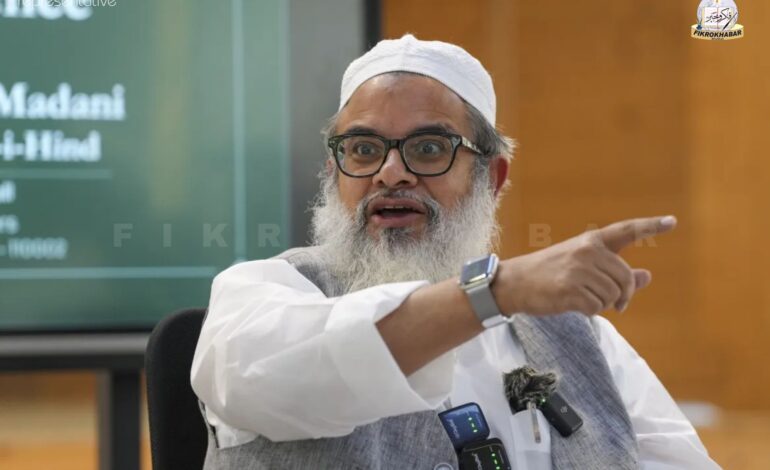

New Delhi (Fikrokhabar News): Jamiat Ulama-e-Hind President, Maulana Mahmood Arsad Madani, has expressed serious concern over the Supreme Court’s interim order regarding the Waqf Act 2025, particularly its remarks on the principle of Waqf by User.
In a strongly worded statement, Maulana Madani said that the court’s comments on Waqf by User—a concept where properties used continuously for religious purposes are recognized as waqf—are deeply troubling and warrant serious reflection.
He noted that Jamiat had raised several grave concerns in court about the amended law. One of the key objections was the transfer of authority to determine the nature of waqf properties from judicial Waqf Tribunals to administrative officers like District Collectors, which, according to him, amounts to state interference in religious matters. While he welcomed the court’s interim stay on this provision and acknowledged partial relief in other areas, he emphasized that the most fundamental issue—the protection of Waqf by User—remains unresolved.
Maulana Madani pointed out that, according to official data, over four lakh waqf properties across India fall under the Waqf by User category. This includes over 1.19 lakh mosques and more than 1.5 lakh graveyards, most of which (over 80%) are not registered. The new amendments effectively nullify the Waqf by User principle, except for those properties already registered—something he said gives a false impression that the damage is minimal.
He further stated,
“Removing Waqf by User from the legal framework contradicts Islamic principles and centuries-old religious traditions. It is a direct attack on the religious rights of Muslims, which are constitutionally protected in India.”
Maulana Madani reiterated Jamiat’s long-held position that waqf is a purely religious and legal matter, and no clause in the law should undermine its religious character or violate the fundamental right to religious freedom.
He added that the Supreme Court’s interim order cannot be considered satisfactory unless full protection is granted to Waqf by User properties.
Expressing disappointment, Maulana Madani referred specifically to paragraphs 143 to 152 of the court’s order, which he said have made the situation even more complex. The court noted that the removal of Waqf by User is not prima facie arbitrary, arguing that since the requirement for waqf registration existed even in the Waqf Act of 1923, non-registration of properties over such a long period weakens the claim to their waqf status.
Concluding his statement, Maulana Madani affirmed that Jamiat Ulama-e-Hind will continue its legal and constitutional battle in collaboration with legal experts and other community institutions to safeguard minority rights and religious freedoms as guaranteed by the Indian Constitution.