SC Stay on Key Waqf Act Provisions Sparks Nationwide Reactions: Relief for Some, Resistance from Others
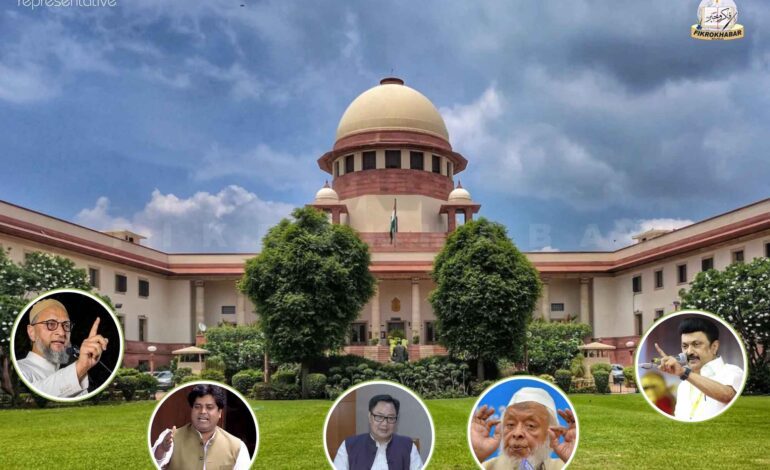

New Delhi: The Supreme Court’s interim order staying several controversial provisions of the Waqf (Amendment) Act, 2025 has triggered a wave of reactions across the political and social spectrum — welcomed by Muslim organizations and opposition parties, while the BJP has defended the law as a well-considered constitutional reform.
Owaisi: Awaiting Final Verdict
AIMIM president Asaduddin Owaisi reminded the public that the ruling is only an interim order and hoped for a swift final judgment.
“The finality of the Act has not been decided. Let us hope they quickly decide the whole issue,” he told reporters.
Muslim Bodies: A Step Towards Justice
Several prominent Muslim bodies, including the All India Muslim Personal Law Board (AIMPLB) and the All India Shia Personal Law Board (AISPLB), welcomed the decision.
AIMPLB executive member Khalid Rashid Farangi Mahali said:
“We wanted the entire law to be stayed, but even this partial relief is significant. It gives us hope for complete justice in the final verdict.”
Mahali also highlighted the court’s direction that the CEO of the Waqf Board should ideally be from the Muslim community — a decision seen as a small but important assurance.
Congress: Victory for Constitutional Values
Congress leaders described the ruling as a win for constitutional and minority rights.
Party president Mallikarjun Kharge said the Supreme Court’s order reaffirms its commitment to protecting minorities.
Senior leaders Jairam Ramesh and Syed Naseer Hussain said the court’s stay on key provisions — such as the powers given to District Collectors and the requirement of five years of Islamic practice to dedicate waqf — protects waqf lands from arbitrary control.
Congress MP Imran Pratapgarhi, one of the petitioners, said:
“The conspiracy to grab Waqf land has been stopped for now. This verdict is a relief for those who feared losing their religious properties.”
Jamiat Ulama-e-Hind: Fight Will Continue
Jamiat Ulama-e-Hind, one of the main petitioners, also welcomed the interim relief but remained cautious.
President Maulana Mahmood Asad Madani warned that without legal recognition of Waqf by User, the future of thousands of unregistered mosques and graveyards remains at risk.
“Our fight is not over. The black law must be repealed in full. The Constitution guarantees religious freedom, and this law directly undermines that,” Madani stated.
BJP: Law Passed After Due Process
In contrast, BJP leaders stood firmly by the law.
Union Minister Kiren Rijiju said the court’s decision reaffirms the Parliament’s authority:
“The decision of Parliament has been upheld. The Supreme Court has not stayed the entire Act.”
BJP MP and former JPC Chairman Jagdambika Pal defended the Act, stating it was passed after 14 hours of parliamentary debate and six months of committee discussions.
Mukhtar Abbas Naqvi, senior BJP leader, accused the opposition of launching a “communal attack” on what he termed a “historic reform.” He said the law is aimed at transparency and ending misuse of waqf lands.
“Waqf land laws aren’t holy texts. Critics want a legal licence to loot. The law ensures accountability,” Naqvi asserted.
Other Political Parties React
Tamil Nadu CM M.K. Stalin, whose party DMK is also a petitioner, said:
“This order is a major step towards undoing the unconstitutional amendments made by the BJP government.”
CPI(M) General Secretary M.A. Baby also welcomed the partial stay, especially on the provision that barred disputed land from being treated as waqf unless approved by the executive.
Key Provisions Stayed by the Supreme Court:
- Five-Year Rule for Creating Waqf: The court stayed the clause requiring individuals to have practised Islam for five years to dedicate waqf property.
- Collector’s Powers: District Collectors can no longer decide the status of waqf properties — the court ruled this violates the principle of separation of powers.
- Non-Muslim Representation: The court capped non-Muslim members in Waqf Boards to 3 out of 11 in state boards and 4 out of 20 in the Central Waqf Council.
The apex court reiterated that the “presumption is always in favour of the constitutionality” of a law, and only exceptional cases justify staying an entire statute.
The Waqf (Amendment) Act, 2025, passed earlier this year, seeks to overhaul waqf property governance. While the government claims it ensures transparency and inclusivity, critics argue it opens the door to state interference in religious affairs.
The case is ongoing, with further hearings expected in the coming months.
Source: PTI / ANI