One Month After Fatehpur Tomb Attack, No Arrests Despite FIR Against Right-Wing Members
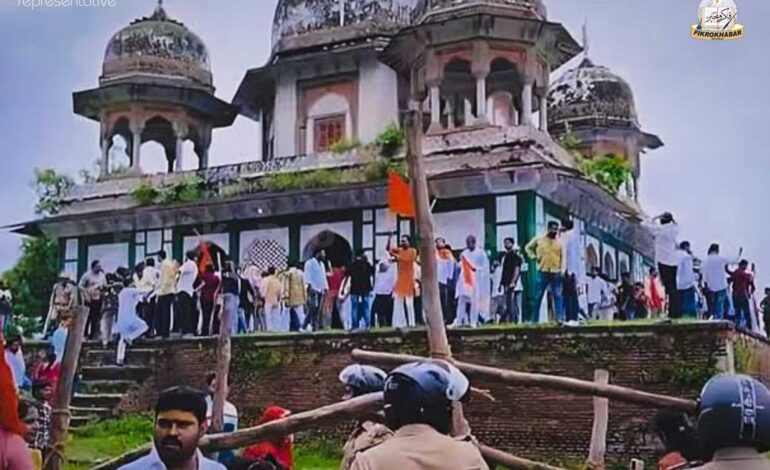

Fatehpur, Uttar Pradesh: A month after a mob attacked and vandalised a 17th-century Mughal-era tomb in Fatehpur’s Abu Nagar, no arrests have been made—even though an FIR was filed naming 10 individuals and 150 others unidentified. The lack of action, despite public video evidence and growing local outrage, has raised serious concerns about the rule of law and political interference in the case.
The incident took place on August 11, when over a thousand members of right-wing groups—reportedly including activists from Bajrang Dal, Vishwa Hindu Parishad, and local BJP leaders—stormed the tomb of Nawab Abdus Samad Khan. Videos from that day show the mob chanting religious slogans, breaking through police barricades, and hoisting saffron flags atop the mausoleum.
Notably, Mukhlal Pal, the district president of the BJP, was allegedly seen leading the mob in some of the viral footage. However, his name does not appear in the FIR registered at Kotwali police station on August 12. The FIR cites sections of the Bharatiya Nyaya Sanhita (BNS), the Criminal Law Amendment Act, and Public Property Damage Prevention Act, yet not a single person has been arrested so far.
Speaking to the media, Kotwali Sadar SHO Tarkeshwar Rai said that the investigation is ongoing and that the accused are being identified through video evidence. However, when pressed about the delay, Rai disconnected the call. Deputy SP Gaurav Sharma later confirmed that there had been “no major developments” and that a chargesheet would be filed soon.
Local residents in Abu Nagar, where the tomb stands, say that while the area is now under tight police surveillance, the fear and frustration linger. “People are being asked to show their Aadhaar cards to enter or exit the area. But what’s the point of all this security when the attackers are still free?” said Zeeshan Mirza, a local resident.
Another resident, standing near the damaged structure, expressed deep disillusionment. “There is no hope of justice when ruling party members are involved. If videos clearly show who led the mob and yet nothing is done, what chance do we have?”
In the Uttar Pradesh Assembly, Parliamentary Affairs Minister Suresh Kumar Khanna admitted that an FIR had been filed against 160 people, but he declined to reveal their names—prompting opposition parties to accuse the government of shielding the perpetrators.
The Incident and its Political Undertones
On August 11, in response to a public call made by BJP leader Mukhlal Pal for a gathering of “Sanatanis,” hundreds of right-wing activists marched from Puri Thakur Dak Bungalow to the mausoleum. Claiming that a Hindu temple once stood at the site, they vandalised the tomb and chanted “Jai Shree Ram.”
The group justified the act by alleging that a “Thakurji Sanwaria Sahab Virajman” temple and a Shivling existed there over a thousand years ago. However, no concrete historical evidence has been presented to support these claims.
Historical Significance of the Tomb
The tomb of Nawab Abdus Samad Khan, built in the 17th century, is the only Mughal-era monument of its kind in Fatehpur. Samad Khan was a faujdar under Emperor Aurangzeb and died in 1699. His son, Abu Muhammad, died two years later. The mausoleum, once part of a larger complex including a tank and pavilions, is a protected national property under official records.
According to the Uttar Pradesh District Gazetteer, the site was commissioned by Aurangzeb himself. Though parts of the structure have deteriorated over time, its historical and architectural value remains significant.
Scholars Speak Out
Professor Heramb Chaturvedi, a historian from Allahabad University, criticised the attack and the silence around it. “Are we heading back to medieval times? Destroying heritage sites to push political agendas is not the way forward,” he said. “Religion should be a personal code of ethics—not a weapon. In a democracy, the Constitution should be the guiding force, not communal hatred.”
He also pointed out that India’s communal tensions were historically manufactured, first by groups like the Hindu Mahasabha and Muslim League, and later deepened by British colonial policies. “The majority of Indian Muslims opposed the partition. We have centuries of shared heritage. Let’s not rewrite history with hate,” Chaturvedi added.
A Community in Waiting
Today, the vandalised tomb remains sealed and heavily guarded. For the residents of Abu Nagar, however, it is not protection but justice they seek. To many, the silence surrounding the case is louder than the chants that once echoed through their streets. The broken stones of the tomb now stand as a stark reminder—not just of the past, but of promises yet unfulfilled.