Jamaat-e-Islami Hind Calls for Peace, Justice and Collective Reform in 2026
JIH leaders urge introspection within the Muslim community and warn of deep intellectual, moral and economic crises facing the nation.
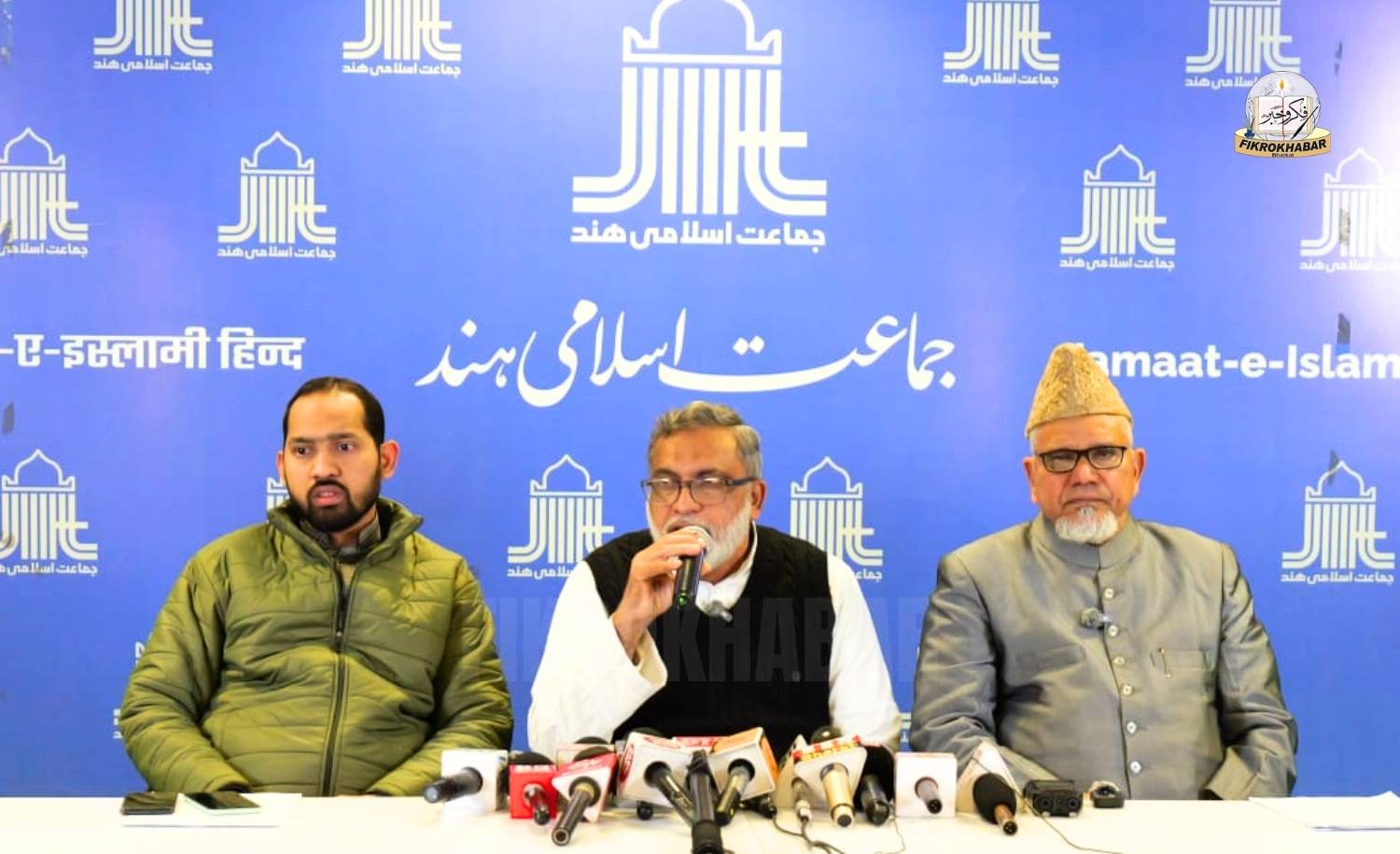

Senior leaders of Jamaat-e-Islami Hind (JIH) have appealed for peace, justice, security, and collective reform in the year 2026, warning that both the Muslim community and the country as a whole are facing serious intellectual, moral, and economic challenges.
Speaking at a monthly media briefing at JIH headquarters in New Delhi on Saturday, Vice Presidents Prof Salim Engineer and Malik Motasim Khan presented a frank assessment of the current situation and called for united efforts to restore ethical values, social responsibility, and national harmony.
Prof Salim Engineer focused on the condition of the Muslim community, referring to the Qur’anic concept of Khair-e-Ummat—a community meant to guide humanity towards good and restrain wrongdoing. He said the community is falling short of this responsibility and is struggling with religious, moral, and social weaknesses.
He noted a visible decline in religious awareness, pointing out that commitment to core practices such as prayer, fasting, and zakat has weakened. “Mosques are often poorly attended, and values like honesty, justice, modesty, patience, and trustworthiness are gradually fading,” he said. According to him, the rise of social evils reflects a deeper crisis of character and discipline.
Prof Salim also expressed concern over the lack of unity and collective responsibility within the community, stressing that meaningful progress is not possible without cooperation and organised effort. He criticised the sharp divide between religious and modern education, the poor management of zakat and charitable resources, and the neglect of social justice.
Despite the availability of resources, he said poverty remains widespread due to poor planning and wasteful spending, especially on extravagant weddings and the continued practice of dowry. He also highlighted the weakening spirit of da‘wah and urged Muslims to act as role models by prioritising peace, justice, and the welfare of all sections of society in India’s plural environment.
Addressing the wider national situation, Malik Motasim Khan spoke about what he described as a deep intellectual crisis in the country. He said reasoned thinking and balanced analysis are increasingly being replaced by blind belief, rumours, and propaganda, leading to confusion and social polarisation.
He identified a widespread moral crisis as another major concern, affecting educational institutions, markets, bureaucracy, politics, and even the judiciary. According to him, policies and programmes often fail because they lack a strong moral foundation, resulting in weakened institutions and declining public trust.
Mr Khan also highlighted severe economic inequality, stating that one percent of the population controls 40 percent of the country’s wealth, while 50 percent of people share just six percent. He warned that such imbalance could have serious long-term consequences for social stability.
He further said the erosion of constitutional values has contributed to regionalism, racism, and extreme forms of nationalism, leading to the marginalisation of vulnerable communities such as Muslims, Dalits, Adivasis, and Christians. Referring to recent incidents, he mentioned restrictions faced by Christian communities, discrimination against Muslims, and difficulties encountered by Kashmiri students and traders in different parts of the country.
On humanitarian efforts, Mr Khan spoke about JIH’s winter relief work, including blanket distribution in North and Northeast India. He stressed that while JIH is a small organisation, broader public participation is essential to support labourers, homeless people, street vendors, and street children during harsh winter conditions.
Concluding the briefing, both leaders called for urgent internal reform, better education, youth development, unity, and responsible use of resources. They appealed to citizens to recognise the interconnected crises facing society and work together to make 2026 a year of peace, justice, unity, inclusive growth, and progress for all.