India Votes in Favour of Palestine at the United Nations
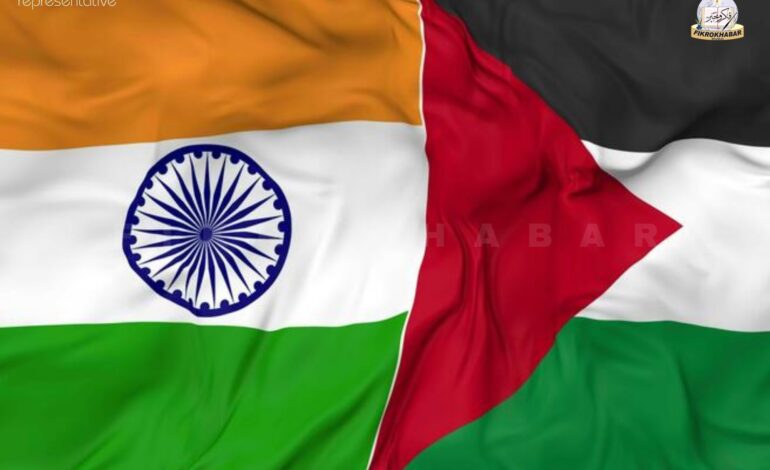

New Delhi: India was among 142 countries that voted in favour of granting Palestine enhanced statehood status at the United Nations General Assembly on Friday, September 12, in what many are calling a historic move toward a two-state solution in the Middle East.
The resolution, formally known as the ‘New York Declaration’, was approved by 142 countries, with 10 voting against—including the United States and Israel—and 12 abstentions.
The resolution received broad global backing from countries such as India, China, Russia, Saudi Arabia, Qatar, the UK, France, Germany, Italy, and Ukraine. The proposal was co-sponsored by France and Saudi Arabia, both of which have emphasized the urgency of finding a peaceful resolution to the Israel-Palestine conflict.
India’s Consistent Support
India’s support for the resolution aligns with its long-standing position on the issue. The Ministry of External Affairs reiterated that India continues to back a negotiated two-state solution.
“India’s policy on Palestine has been consistent and long-standing. We support the creation of a sovereign, independent, and viable Palestinian state, living side-by-side with Israel in peace and security,” said Minister of State for External Affairs Kirti Vardhan Singh in a Rajya Sabha reply dated December 13, 2024.
India has also supported Palestinian membership in the UN. According to official records, in the past five years, India has voted in favour of 54 UN resolutions related to Palestine, while abstaining on only eight. However, in recent years, India abstained from several resolutions calling for a ceasefire in Gaza, most recently on June 12, 2025, citing what it called “lack of dialogue and imbalance in the resolution’s language.”
Despite these occasional abstentions, the Indian government insists that its core policy has not changed.
Global Reactions
Following the UN vote, French President Emmanuel Macron welcomed the move, calling it a “concrete step” toward peace.
“This is an irreversible move toward lasting peace. The New York Declaration sets a clear path toward the implementation of the two-state solution,” Macron said.
France had already declared its intention to recognise Palestine as a state back in July 2025. In a social media post, Macron stated, “Peace is possible. The immediate priority is a ceasefire in Gaza and humanitarian relief for civilians.”
Several European Union countries, including Spain, Ireland, Sweden, and Slovenia, have already recognised Palestine. Historic recognitions also came from Poland and Hungary during the 1980s.
US and Israel Oppose the Resolution
The United States opposed the declaration, dismissing it as a “publicity stunt” that undermines ongoing diplomatic efforts in the region.
In a statement, the US mission to the UN said:
“The timing of this resolution is counterproductive. It benefits Hamas and risks derailing efforts to release hostages and end the war in Gaza. This is not serious diplomacy—this is politics.”
Israeli Prime Minister Benjamin Netanyahu, who visited the Adumim settlement in the occupied West Bank before the vote, also rejected the idea of Palestinian statehood.
“Palestine will never be granted nation status. This land belongs only to Israel,” he said.
What the Vote Means
Though the New York Declaration does not make Palestine a full UN member state, it is being seen as a symbolic but significant diplomatic win. The vote amplifies Palestine’s political legitimacy on the world stage and applies pressure for renewed peace negotiations.
With over 140 of the 193 UN member states now having recognised Palestine as a state, global momentum appears to be building, despite opposition from key allies like the US and Israel.